
Online Bingo in the UK: Rooms, Tickets and Slots
 Available in GB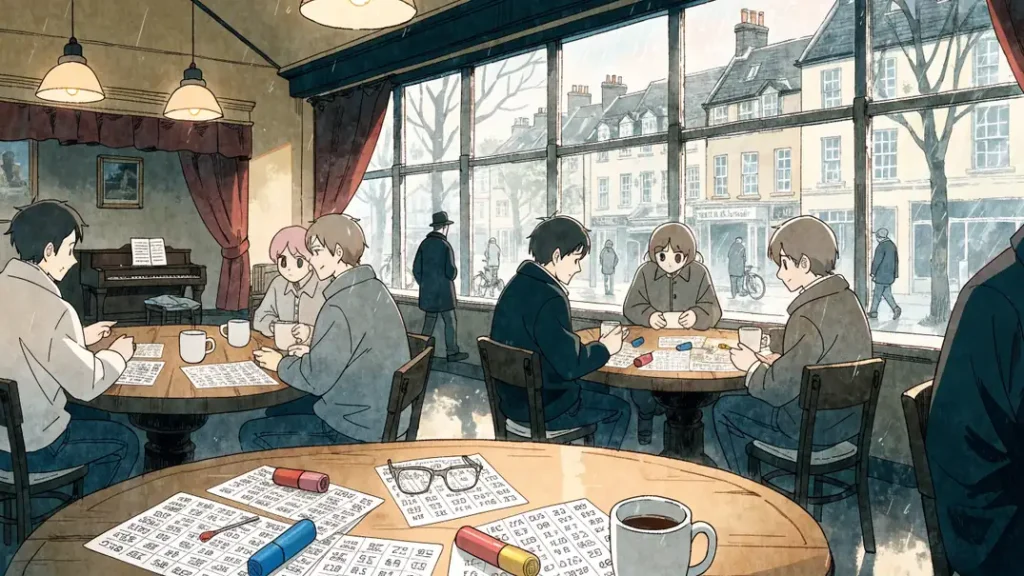
Bingo rooms and casino floors may share a platform, but tickets, draws and patterns work differently from separate casino games.
Bingo Rooms and Casino Floors Under One Roof
An online platform can place bingo and casino games under the same digital roof without turning them into one game. The shared setting may make the two appear to belong to a single entertainment offer, but their basic arrangements remain different. Bingo is organised around tickets, a sequence of drawn numbers and the completion of a pattern. Casino games follow their own rules and do not become bingo merely because they sit beside a bingo room.
That distinction matters more than the lobby’s design. A menu can group games by mood, popularity or format; a banner can lead from one section to another. Yet the activity inside each game is still defined by how it works. In bingo, the room is a social and procedural space: tickets enter a game, numbers are called, and a result emerges as players follow the draw. A casino floor, by contrast, is a collection of separate games, each with its own mechanics. The common platform is an address, not a shared rulebook.
The modern online bingo room inherits something of the public hall. In the physical version, people gathered around a caller, listened for numbers and watched for the moment a ticket became a claim. The digital room removes the shared building, but preserves the central ritual: a draw, a ticket and a pattern that turns chance into a recognisable event. Its online setting can make it part of a broader casino service, while the form of play remains unmistakably bingo.
This is why “online bingo and casino” describes a pairing rather than a hybrid game. The bingo room may be presented alongside casino entertainment, but the ticket-and-draw format gives it a separate identity. The casino games may sit nearby, yet they are not simply extra stages in a bingo round. Keeping that boundary clear helps explain what a combined site is offering: one platform, distinct forms of gambling.
American Roulette Casinos in the UK: Licence Checks
There is a quiet social history in that arrangement. Bingo has long depended on shared attention, even when the players are not speaking to one another. A room gives the game its collective shape: the same call reaches everyone, while each ticket produces a private calculation. A casino interface tends to organise play around individual games and choices. Online platforms bring these habits into one digital space, where the border between communal ritual and solitary entertainment is mostly a matter of navigation. Conveniently adjacent; conceptually separate.
The legal structure reflects that separation less through the appearance of a website than through the services it provides. Online bingo is lawful in the United Kingdom, but it operates within a closely regulated gambling system. An operator wishing to serve UK players must hold the appropriate, separate UK Gambling Commission licence. A broad entertainment brand does not replace that requirement, nor does placing bingo and casino games on the same screen make the regulatory obligation disappear.
The UK Gambling Commission’s standards reach beyond the mere existence of a licence. They cover fairness, measures against money laundering and responsible gambling. Those requirements express a particular view of the market: gambling may be offered as a commercial activity, but its operation is not left entirely to the operator’s own customs. Rules apply to the organisation behind the games, not just to the labels attached to them.
Monopoly Live Casino in the UK: Format and Play
The statutory framework has geographical edges, too. The Gambling Act 2005 provides the principal gambling legislation for England, Wales and Scotland; Northern Ireland is not governed by that Act. This distinction does not turn the online offer into an unregulated free-for-all. It is a reminder that “the UK” is often used as a convenient market description for jurisdictions whose legal arrangements are not identical. The neatness of the website’s menu should not be mistaken for the neatness of the law.
For a service combining bingo and casino entertainment, licensing is therefore not a decorative assurance placed beside a logo. It is part of the legal basis on which the operator can offer gambling to the relevant UK market. The licence requirement applies to the operator and the services it provides; a familiar name, polished interface or wide catalogue cannot stand in for it. In a market where several kinds of game share one destination, the regulatory question belongs to the platform as a whole, while the rules of play still belong to each game.
A combined site gathers different gambling products into a single online setting, but it must still operate within the UK licensing system applicable to the specific services it offers.
A combined site can consequently be understood in two ways at once. Commercially, it gathers different gambling products into a single online setting. Structurally, it preserves the difference between a bingo room and casino games. Legally, it must sit within the UK licensing system applicable to the services it offers. The room and the floor share an address. They do not share a game, and neither escapes the rules attached to the operator.
When Bingo Tickets Share Space with Slots
A bingo room and a slot lobby can occupy the same online account without becoming the same game. The distinction is easy to blur on a page crowded with tiles, badges and invitations to try something else. Yet bingo still centres on a ticket and a draw: numbers are called, and a win depends on completing the required pattern. A slot, by contrast, is a separate game with its own rounds and outcome. Shared space is not shared structure.
That difference matters when a site presents bingo and slots side by side. The room may keep its own schedule, ticket selection and draw, while a link or lobby tile leads to a slot game. The player moves between products; the underlying bingo round does not quietly turn into a slot round. A platform may make the transition feel seamless, but the games remain distinct. The design joins them; the rules do not.
There is an occasional bridge between the two. One specialist review describes an offer in which a bingo ticket purchase is paired with a free slot spin. That is a particular promotional arrangement, not a defining feature of online bingo and not a promise that every ticket brings a spin. Its appeal is plain: a familiar purchase is made to open a door to a different game. The small print matters because the spin belongs to the offer, not to the ticket-and-draw format itself.
Online Casino Without ID in the UK: What It Means
The pairing also changes how a lobby tells its story. A bingo ticket is part of a shared event: several players may follow the same draw, waiting to see whether their tickets complete the pattern. A slot game is presented as its own play. Putting both within one site can make the experience feel like a single evening’s entertainment, but the social rhythm of a room and the solitary pace of a slot are not interchangeable. One is organised around a common draw; the other does not need that gathering to function.
This is why “bingo slots” can be a misleading label if taken literally. It may describe a site where bingo and slot games sit together, or a promotion that links one activity to the other. It does not mean that the bingo ticket has become a slot machine, nor that slot outcomes determine the bingo draw. The phrase belongs more to the commercial arrangement than to a new game type. A tidy label, perhaps. A tidy explanation, not always.
The difference is more than presentation. Side games can have lower return-to-player percentages than the bingo room itself. That does not predict the result of an individual game, and it is not a measure of whether a particular player will win. It is a reminder that games grouped under one roof need not share the same mathematical profile. A slot attached to a bingo promotion should be considered on its own terms, rather than treated as an extension of the room’s draw.
Bingo Room
Organised around tickets, a sequence of drawn numbers, and the completion of a pattern.
Slot Game
A separate game with its own rounds, outcomes, and mechanics.
Promotional Link
A commercial arrangement, such as a bingo ticket purchase paired with a free slot spin.
Promotional language can make that separation seem smaller than it is. “Play bingo and slots” may sound like one continuous activity, but each part has its own rules and conditions. A ticket may qualify for an offer; a spin may then be provided under the offer’s terms. The ticket still participates in bingo, while the spin belongs to the slot game. Reading the two as one combined chance would muddle the mechanics.
The architecture is familiar beyond gambling: a shared entrance, distinct rooms. The operator benefits from keeping attention within one account and one lobby; the player encounters a wider range of games without leaving the platform. But convenience of navigation is not evidence that two products carry the same character, or the same return. Online bingo and slots can share a site, a promotional banner and even a single sequence of clicks. Their resemblance ends there.
For UK players, the useful distinction is simple: the bingo room is defined by tickets and draws, while slots are separate side games, sometimes linked through an offer. The link may be attractive, but it should not obscure what is being played. Different games, different terms.
Real-Money Play, Ticket Prices and the Prize at Stake
A real-money bingo room puts a price beside a small, familiar object: the ticket. The cost may be only a few pence, or it may reach a pound or more in a premium game. Penny rooms can start at 1p or 2p, while some higher-stakes rooms offer tickets costing £5 or more. These are not merely different prices for the same social ritual. Each ticket buys a chance at the prize pool attached to that particular game.
Online European Roulette in the UK: Wheel and Odds
The amount spent on a ticket is only one part of the calculation. A game with cheaper tickets may carry a modest prize; a more expensive room may advertise a larger one. But a bigger possible return does not turn the ticket into a better value by itself. The number of tickets sold, the prize structure and the chance of sharing a win with other players all shape what the game means in practice. Bingo has always made its arithmetic public, even when the odds remain less vivid than the numbers on the card.
One specialist review described a 1p game with a £10 full-house prize and a £1 game with a jackpot in the hundreds or thousands. That comparison is an illustration from a review, not a standing promise about online bingo rooms. Prize pools change from game to game, and an advertised jackpot belongs to its stated terms and draw. The figures show how sharply the potential prize can vary with the room; they should not be mistaken for a fixed conversion rate between ticket price and winnings.
This is where “real money” can sound more definitive than it is. The phrase distinguishes paid play from a free offer, but it says nothing by itself about the likely return on a ticket. A higher ticket price does not guarantee a win, and a low-cost game is not automatically trivial: the sum at stake is small, but the outcome still matters to the person playing. The sensible comparison is between the ticket cost and the prize structure of the particular game, not between a cheap room and a jackpot headline taken out of context.
Bingo Ticket Costs
Penny rooms can start at 1p or 2p, while some higher-stakes rooms offer tickets costing £5 or more. Each ticket buys a chance at the prize pool attached to that particular game.
There is also a difference between the prize shown and the money ultimately kept. In the United Kingdom, recreational players do not pay tax on online bingo winnings. That treatment makes the prize less complicated than income from work or a taxable investment, though it does not alter the uncertainty of the draw. A win remains a win; it is not evidence that the next ticket will follow suit.
Online bingo and slots may occupy the same commercial site, but their money logic is not interchangeable. A bingo ticket buys entry to a shared draw, where other players are competing in the same room. A slot stake is placed on an individual game outcome. Looking at both as one general pot of “real-money play” obscures the distinction that matters most: what is being paid for, and how the prize is determined.
The ticket is a modest unit of spending, but its price sets the tone of the room. At the low end, the appeal may be the small outlay and the company of a shared game; at the high end, the advertised prize can dominate the invitation. Neither tells the whole story without the rules of that game and the cost of taking part. The arithmetic is plain. The expectation is not.
What a Bingo-and-Slots Site Can—and Cannot—Promise
A site that puts bingo and slots under one account can look like a single entertainment room, but its welcome banners cannot establish that it is one of the best places to play. “Best” depends on what matters to a player: the bingo rooms available, the games on offer, the terms attached to promotions, or the quality of the mobile experience. A ranking that does not show how those judgements were reached is a verdict without a measuring stick.
Online Casino Games for Real Cash in the UK
That matters particularly when a site is new. Fresh branding and a polished lobby may suggest novelty; neither says much about the standards behind the service. A newly launched operator still has to meet the same basic legal requirement as an established one if it offers gambling to people in Great Britain. It must hold the relevant UKGC licence. Familiarity is not a substitute for that permission, and a new name is not evidence of a problem either. The licence is the useful fact.
Start with the licence, not the banner
A UKGC licence is more than a decorative badge. The Commission’s requirements cover fairness, anti-money laundering and responsible gambling. Those obligations concern the operator and the way it runs its service; they do not certify that every promotion is generous, that every game will suit every player, or that a particular site deserves the label “best”.
The licence number should be displayed prominently in the site footer. It can then be checked against the UK Gambling Commission’s public register before a deposit is made. If a gambling site does not prominently show its UKGC licence number in the footer, close the tab immediately. That is a plain test, not a matter of taste.
A site may use confident language about trust, quality or a smooth experience. Such claims should not be confused with the regulator’s role. The Commission’s licence gives a legal and regulatory basis for operating in the market; it is not an endorsement of the operator’s marketing copy. A boast remains a boast.
Do
- Check that the UKGC licence number is displayed prominently in the site footer.
- Verify the licence against the UK Gambling Commission’s public register.
Don’t
- Mistake a polished interface or brand name for a regulatory licence.
- Assume marketing claims about being the “best” are verified measurements.
Read claims as claims
Promotional language tends to compress a complicated service into a handful of attractive phrases. “More choice” may refer to games, rooms or promotional formats, while “a better experience” is an opinion unless the basis for it is made clear. Claims about the best bingo-and-slots sites are most useful when they explain the criteria and distinguish observed details from judgement. Without that distinction, a ranking can make preference look like measurement.
The same restraint applies to mobile claims. A site may present itself as especially well suited to a phone, but that phrase alone does not show how the lobby behaves or how clearly its terms are presented on a smaller screen. The practical question is what the service actually makes available and how plainly it explains it, rather than whether a banner has found a flattering adjective.
Promotions deserve the same careful reading. A headline can describe an offer without revealing all the conditions that shape it. The offer’s own terms are the place to establish what applies; a general claim that a bonus is “generous” does not settle the matter. The distinction is small in print, and large in consequence.
The most defensible comparison is therefore not a universal league table. It is a set of questions: does the operator hold a UKGC licence, is its licence number displayed where it should be, and do its claims explain what they mean? Those checks do not identify a perfect site. They do separate verifiable regulatory status from advertising’s preferred version of reality.
A licence is a threshold, not a medal.
Live Casino Lightning Roulette in the UK: Licensing
Free Play Is Not Always Free of Conditions
A free bingo ticket is a chance to enter a draw without paying for that entry; it is not cash sitting in an account. The distinction matters when a ticket wins. The ticket itself cannot be withdrawn, and any resulting winnings may be credited as cash while remaining subject to a wagering requirement. The apparent gift can therefore arrive with another task attached.
The terms may narrow the ticket’s use before a game even begins. A specialist review of an offer described free tickets limited to named rooms or ball types, with a stated expiry of 24 hours. That is one reported offer, not a rule applying to every bingo room. A ticket tied to a particular format cannot simply be treated as a general pass to any draw, and a missed expiry leaves no entry to use later.
The same caution applies to winnings. One specialist review reported free-ticket winnings subject to wagering requirements ranging from 20x to 65x. The operator’s terms determine what that means in practice: which balance must be wagered, which games count, and whether bingo play qualifies in full. A cash credit is not necessarily withdrawable cash. It may have to be played through first, and the route to completing that condition can matter as much as the headline value.
There is an important difference between a free ticket and a free spin. Some bingo rooms have been described in a specialist review as offering a slot spin for each ticket bought. Despite the word “free”, that spin is attached to a purchase; it is not an unconditional reward. Its own terms may govern eligible games, any winnings and whether those winnings can be withdrawn or must meet a wagering requirement.
Attention A free ticket is not cash; any resulting winnings may be subject to wagering requirements that must be met before they can be withdrawn.
This is where offers involving free online bingo and slot games can blur two very different things: an entry to a bingo draw and a turn on a slot. Neither label settles what happens to a prize. The conditions do.
The useful reading is therefore not limited to the offer banner. The full terms should identify the eligible room or game, the expiry, and what happens to winnings from the ticket or spin. If a wagering requirement applies, its calculation and eligible play should be clear before acceptance. A free ticket may cost nothing to enter, yet still place restrictions on the prize it produces. Free, with qualifications.
The Bingo Patterns Behind the Modern Online Room
A bingo ticket is not merely a set of numbers waiting for a draw. Its layout tells players what counts as progress, and each format gives that progress a different shape.
In 90-ball bingo, the ticket has three rows and nine columns. Prizes are tied to completing one line, then two lines, and finally the full house. The sequence gives a game its familiar sense of stages: an early winner may emerge before the larger task of completing the ticket is settled. “Full house” is not decoration; it names the final pattern.
The 80-ball format rearranges the ticket into a square grid, with coloured patterns setting the target. A win might depend on marking the four corners, tracing a letter shape, or covering the full card. Here, the eye has more work to do than simply follow a line across a row. The pattern is part of the game’s grammar.
Mines Casino Game in the UK: What to Know
In 75-ball bingo, the ticket is also square, but the winning pattern can take several forms: a cross, an X, a diamond, a letter T or a picture frame. Numbers still arrive one by one, yet the task is not necessarily to complete a row. The same draw can look promising or unremarkable depending on the pattern in play.
These formats show how bingo’s rules turn a random sequence into a shared contest. A number is called; players compare it with their tickets; the pattern decides whether that mark matters. The social rhythm comes from everyone tracking the same draw while holding a different arrangement of numbers. Rules make the suspense legible.
The names of rooms do not always tell the whole story. The useful distinction is the ticket and the condition for winning: lines in 90-ball, coloured shapes in 80-ball, and specified patterns in 75-ball. Once those are clear, the game’s pace and visual demands are easier to recognise, even before a room’s other features enter the picture.
A small geometry of chance.
A Slot Machine in a Bingo Lobby
A “bingo slot machine” online is not a machine that draws bingo numbers. It is a slot game presented within, or alongside, a bingo room: the familiar reels and symbols belong to a separate game, even when the lobby makes both activities feel like parts of one evening’s entertainment. The label describes where the game is encountered, not a new way of playing bingo.
RTP
Return to player (RTP) is a theoretical measure of how much a game returns across extensive play, rather than a forecast for an individual session.
That distinction matters because the two products measure outcomes differently. Bingo turns on tickets, drawn numbers and a pattern completed against other players. A slot game produces its own result with each spin. The shared screen or account does not make the games’ rules, odds or return characteristics identical.
Return to player, or RTP, is a theoretical measure of how much a game returns across extensive play, not a forecast for an individual session. Side games often have lower RTP percentages than the bingo room itself. That difference can disappear behind bright graphics and a familiar lobby, but it remains a meaningful distinction: a slot’s design and terms deserve attention in their own right. A shared doorway is not a shared calculation.
The term can also obscure the fact that online slots are subject to specific rules in Britain. Autoplay is banned, and each online slot spin must last at least 2.5 seconds. Those rules shape the pace of play, even when a game is reached from a bingo page rather than a casino-labelled menu. The slot is still a slot.
There is a small social history in this arrangement. Bingo rooms were built around a collective event: numbers called, attention shared, a winner emerging from the same draw. Slots bring a more private rhythm, one spin following another, with the player’s focus narrowed to the screen. Placing them side by side lets an operator serve both habits, without making them the same habit.
So the phrase points to a location and a category, not a hybrid game. The bingo lobby may contain a slot machine in digital form; its return profile, pace and play rules belong to the slot. Different games, different terms.
Plinko Casino UK: Games, Rules and Payments
Can a Bingo Site Also Offer Slot Games?
Yes. An online bingo site can place slot-style games beside its bingo room, so the same account may open onto two different forms of play. Their shared address does not make them the same game. Bingo turns on tickets, drawn numbers and a pattern completed ahead of other players; a slot game is a separate side activity, with its own rules and outcome.
That distinction matters because the bingo room has a social structure built into its format. Tickets belong to a particular draw, and the result emerges as numbers are called and players complete the required pattern. Slot play does not depend on that shared sequence. It sits alongside the room, rather than changing what a bingo ticket means.
The two products may also differ in their return-to-player figures. Side games can return a smaller proportion of stakes over time than the bingo room’s game. Those figures describe different formats, and they should not be read as a promise about the result of an individual session. A lobby may make the games look like neighbours; their mathematics need not be equally generous.
There is a regulatory line as well as a gaming one. An operator offering gambling services to people in the UK must hold a separate UK Gambling Commission licence for the relevant service. A bingo brand’s presence, or a familiar-looking lobby, is not a substitute for that licence. The UK system treats the permission to offer gambling as a matter of operator accountability, not a decorative badge attached to a game.
Essential Distinction
While bingo and slots can share a platform, they remain distinct products with different rules, mathematics, and regulatory requirements.
For players, then, the practical answer is that slots may be available on a bingo site, but their presence does not turn them into part of the bingo draw. Each remains a distinct product under the same operator, and the operator’s UKGC licence is the condition that makes offering gambling services to UK customers lawful. The room and the side game share a doorway. Not a rulebook.
Bingo and Slots on a Phone, Without Losing the Room
A phone changes the shape of the bingo room, not the game at its centre. The screen may be smaller, but the sequence remains familiar: a ticket is bought, numbers are drawn, and a win depends on completing the required pattern before other players do. Mobile access is a different doorway into the room, not a new form of bingo.
That distinction matters on platforms where bingo and slots appear side by side. A slot game is built around its own play cycle; the bingo room keeps its shared draw and ticket-based contest. Moving between them on one device does not make their rules interchangeable. The lobby can put both within reach, while the games themselves retain separate identities.
The phone does make the room’s practical limits more visible. Bingo rooms commonly restrict how many tickets can be bought for a game, with the cap often falling between 10 and 50 according to ticket price. A crowded screen does not enlarge that allowance. Nor does buying more tickets alter the basic contest: the draw still unfolds, and patterns still decide who wins.
There is a small social history in the persistence of that format. Bingo was built around a roomful of people following the same numbers, even when the room is now carried in a pocket. The screen compresses the furniture and removes the walk to the hall; it does not erase the shared anticipation of a draw. Modern convenience, old collective suspense.
Keno Online Casinos in the UK: How Payouts Work
For anyone comparing mobile bingo and slot sites, the useful distinction is therefore not simply whether both games load on a phone. It is whether the bingo area remains legible as a room with its own tickets, draws and patterns, rather than being treated as decoration around the slots. The compact display can make menus feel crowded, but it cannot change what counts as a bingo win.
Same draw. Smaller screen.
No-Deposit Offers and the Clock on Bonus Play
A “no-deposit” label describes how an offer is entered, not what its balance is worth in cash. A bonus can appear in an account without being immediately withdrawable: the terms may require eligible play first, and may distinguish between the bonus amount and any winnings generated from it. The wording matters more than the label.
One specialist review describes a new-player package combining a £10 cash bonus with 30 bingo tickets. That is a reported offer, not a promise that every site will make the same deal. Packages change, and their components can carry separate rules: tickets may be confined to particular games, while cash bonuses may have their own wagering requirement. A slot element in a bingo-and-slots promotion does not, by itself, make the bingo and slot conditions interchangeable.
For deposit-based bingo offers, specialist reviews report wagering requirements ranging from 20x to 65x; some count only the bonus funds, rather than the deposit as well. That difference changes the amount of eligible play needed before a withdrawal can be requested. The headline figure alone is not enough: the terms must say what balance is multiplied, which games count, and whether bingo and slots contribute on the same basis.
The clock is another quiet condition. A specialist review describes a 30-day wagering window beginning when the bonus is credited. Under that kind of rule, waiting to decide whether an offer is useful does not preserve the time available to complete its requirements. The start point may be the moment the bonus lands, not the first session of play.
A no-deposit offer can therefore have no entry payment and still impose meaningful conditions. The practical comparison is between what is credited, what play qualifies, how wagering is calculated, and when the offer expires. A bright banner is brief; the terms are where the timetable lives.
Can I play bingo without buying a ticket?
Yes, some offers include free bingo tickets. They may be limited to particular rooms or bingo formats and can expire after 24 to 72 hours.
Are the promoted bingo sites licensed by the UK Gambling Commission?
A site offering bingo to UK players must hold the appropriate UK Gambling Commission licence. Check that the operator holds a licence for the services it offers.
When is the best time to play for smaller prize pools?
Try playing outside the peak hours of 7pm to 11pm, when operators schedule their largest prize pools.
How do 90-ball and 75-ball bingo differ?
90-ball bingo uses a 9×3 ticket, with prizes for completing one line, two lines and a full house. 75-ball bingo uses a 5×5 grid, and players win by completing patterns such as a cross, X, diamond, letter T or picture frame.