
Online European Roulette in the UK: Wheel and Odds
 Available in GB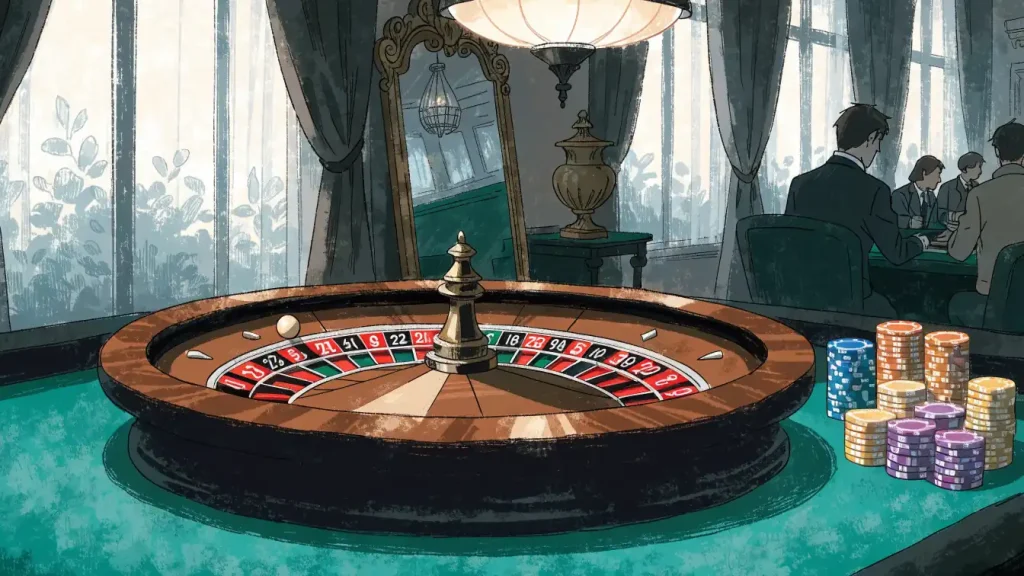
A practical guide to the single-zero wheel, its payouts, live and digital formats, and the terms that can shape roulette play.
The European Wheel: One Green Pocket, Not Two
The European roulette wheel is defined by an absence: there is no double zero. Its rim contains 37 pockets, numbered from 1 to 36, with one green pocket marked zero. That single extra pocket sits outside the numbered run, changing the arithmetic beneath the game. The wheel looks like a circle divided into destinations; mathematically, it is a set of possible outcomes, and each spin ends in one of them.
The distinction matters because the numbered sequence is not the whole wheel. A person seeing 36 numbers might imagine that each has an equal contest against the others and that the game is therefore balanced. But zero is a genuine outcome, not decoration or a pause between numbers. It belongs to the same set of 37 pockets and is what gives the house its statistical advantage.
On a European wheel, the chance of any particular pocket is one in 37, assuming a properly functioning wheel and a fair random process. That is a statement about a single outcome, not a prediction about what the ball will do next. A number that has appeared repeatedly does not become less available; one that has been absent has not accumulated a claim. The wheel keeps no memory. Human beings, naturally, keep detailed accounts of one.
This is where the house edge enters. European roulette has a house edge of 2.70%. In plain terms, the figure describes the casino’s expected advantage across play over time, rather than a fee visibly removed from every spin. A short session can depart sharply from that expectation. The edge is a property of the rules, not a promise about what will happen in any particular run.
Its source is unusually easy to see. The numbers offer a field of apparent symmetry, while the green zero interrupts it. Without that pocket, the arrangement of outcomes would have a different mathematical balance. With it, wagers built around the numbered outcomes face an additional possibility that does not belong to red or black, odd or even, high or low. The green pocket is small in physical area, but no smaller in consequence.
Online Casino Games for Real Cash in the UK
That contrast has helped make roulette legible to people who may never care for complicated rules. The wheel presents a compact picture of chance: coloured sections, a circling ball, then a final resting place. The mathematics underneath is less theatrical. It is a ratio between the outcomes available and the returns defined by the rules. The house edge summarises that relationship, while the spinning wheel gives it a public performance.
Online, the same structure can appear as a rendered wheel or as an image of a physical one, but the word “European” describes the pocket arrangement, not the screen. The essential reference remains 37 pockets and a single zero. For anyone comparing online versions, that is a more useful starting point than graphics, music or the speed of the animation. A polished interface cannot remove a pocket from the underlying arithmetic.
The design also shows how a game can make a disadvantage look like part of its scenery. Green is visually distinct, but the zero is not an ornamental flourish added to make the wheel more colourful. It is the outcome that alters the terms. The rest of the wheel may invite pattern-spotting: clusters, runs, remembered sequences. None changes the count of available pockets or the house edge attached to the game.
There is a quiet social ingenuity in that arrangement. The player sees a simple physical object and a choice among visible possibilities; the operator relies on a rule that is simple enough to remain unobtrusive. No hidden mechanism is required. The advantage is printed into the wheel’s design, one green pocket among the numbered ones. Plainly stated, it is enough.
That is the common reference point for European roulette: a single-zero wheel, 37 possible landing places, and a house edge of 2.70%. Those figures do not say which pocket will receive the ball. They describe the terms under which every spin takes place. The wheel offers suspense; the arithmetic supplies the less dramatic account.
Reading the Table Before the Ball Moves
The European roulette table is a map of the wheel translated into felt and printed numbers. Its long betting grid gathers the numbered pockets into rows and columns; beside it sits a separate area for the zero. The arrangement is not a miniature of the wheel’s circular order. It is a working surface, built to let several kinds of selection occupy the same space.
European Roulette
Single-zero wheel
House Edge
2.70%
Total Pockets
37
Numbers run from 1 to 36 in three columns, with twelve numbers in each. Read across a horizontal row and the numbers form a street; read down a column and they form a dozen. The three columns also divide the grid into low, middle and high groups. These labels describe positions on the layout, not a prediction about where the ball is likely to land.
The numbers alternate red and black, while zero is green. Colour is a visual aid, not a clue to the wheel’s sequence: neighbouring squares on the cloth need not sit beside one another on the circular wheel. That distinction matters. The table organises choices; the wheel determines the result.
A European layout contains 37 pockets altogether: 1 to 36 and one zero. On the cloth, zero is generally set apart at the head of the numbered grid rather than placed in one of its three columns. That small separation makes its role legible before any chips are placed. It belongs to the same wheel, but not to the red-and-black pattern of the numbered field.
The remaining spaces around the grid group numbers by shared properties. These outside areas sit beyond the individual-number boxes and the rows and columns. A chip placed there marks a broader category; a chip inside the grid points to a narrower part of it. The geometry is practical: the table has to make both kinds of choice visible without turning the cloth into a maze.
That is the useful way to read a European roulette casino table layout: first locate zero, then the numbered grid, then the surrounding bands. The grid’s architecture explains where a selection is made, but it does not make one square more fortunate than another. No pattern in the printing can tell the ball where to fall. The felt is an index, not an oracle.
Online Casino Without ID in the UK: What It Means
For anyone arriving at the table for the first time, the unfamiliarity is mostly visual. Once the three-column structure is recognised, the marks become a compact language of positions: single squares, linked edges, rows, columns and broad outer groups. The wheel and cloth speak different dialects. One is circular and ordered; the other is rectangular and convenient.
Single-Zero Bets and What They Pay
On a European single-zero table, a bet is priced according to how many numbers it covers and how much it pays if the ball lands on one of them. The distinction between inside and outside wagers is practical: inside bets sit among the numbered choices, while outside bets cover broader groups. Neither changes the spin. They change the terms attached to it.
An inside bet can name a single number, or cover a small cluster. A straight-up wager selects one number and pays 35:1 if it wins. That return is striking because the selection is narrow; the wheel gives it no special favour. The same straight-up price applies on American roulette, though that variant has an additional green pocket and a different house edge. The payout alone does not tell the whole story.
A split covers two adjacent numbers on the table and pays 17:1. It is a compromise between the concentrated choice of a single number and a wider selection. The table’s neighbouring positions determine whether a split can be placed; the wheel’s sequence does not. That distinction matters. A wager is made on the layout, while the result comes from the ball’s position on the wheel.
Straight-up bet
Example: 35:1 × £1 = £36 total.
Outside bets trade precision for breadth. Red or black, odd or even, and high or low each pay 1:1 when successful. They are often called even-money bets, a description of their payout rather than a promise of equal chances: the zero remains outside those categories. On a standard European table, that pocket is the reason the house edge persists even when the choice appears evenly divided.
There is an important exception to the ordinary treatment of zero. Under La Partage, if the ball lands on zero, half of an even-money bet is returned rather than the whole stake being lost. The rule applies to those broad outside bets, not to every wager on the table. It lowers the house edge on eligible bets to 1.35%. A small concession, mathematically speaking; still a concession.
The difference between payout and probability is easy to blur. A high quoted return on a single number reflects the narrowness of the selection, not a better chance of success. Conversely, the modest 1:1 return on red or black does not make those bets immune to the green pocket. Roulette’s prices are built around that pocket, and even-money labels cannot erase it.
For anyone comparing betting options, the useful questions are therefore straightforward: what part of the table does the wager cover, what is its stated payout, and does La Partage apply if zero appears? The answer may make a familiar bet less simple than it looks. At the felt, terms do the talking.
Online Bingo in the UK: Rooms, Tickets and Slots
European, American and French: Three Different Price Tags
The difference between European and American roulette is not merely the shape of the table or the name above it. It is the price built into the wheel. European roulette has 37 pockets: numbers from 1 to 36 and one zero. American roulette adds a double zero, making 38 pockets in all.
That extra green space matters because it gives the house another winning result without changing the familiar straight-up payout. On a European wheel, the house edge is 2.70%; on an American wheel, it rises to 5.26%. The American version is therefore a more expensive game in mathematical terms, even when the wager and its stated payout look the same.
The difference is easy to overlook on screen. Both wheels present a sequence of numbered pockets, and both invite the same basic choices. Yet the double zero changes the odds behind those choices. It is not decoration. The house has acquired another route to collect.
French roulette belongs in the comparison for a different reason. Its advantage comes from rules rather than a more favourable-looking layout: La Partage and En Prison reduce the house edge on eligible even-money bets, and French roulette has the lowest house edge among the standard variants. Those rules soften the cost of a zero; they do not make the result predictable.
This is why variant names deserve attention before the first spin. “Roulette” describes a family of games, not one fixed set of terms. European roulette sits between the higher-cost American version and French roulette’s more favourable treatment of certain bets. The wheel sets the arithmetic; the rules decide how much the zero can take.
A small green pocket, with a large consequence.
European Roulette
Single-zero wheel with 37 pockets.
American Roulette
Double-zero wheel with 38 pockets.
French Roulette
Features La Partage and En Prison rules.
A Wheel on Screen, or a Wheel in a Studio
An online casino with European roulette may offer two quite different versions of the same game. In one, software generates the result and animates a wheel; in the other, a camera follows a real wheel in a studio. Both can present the familiar European layout, including its single green zero. The screen may look much the same. The source of the spin does not.
RNG roulette uses a random number generator to produce each result. The wheel and ball are visual representations of that process, rather than physical objects being filmed. This format tends to move more quickly than live play and can have lower minimum stakes; some games allow bets from as little as 10p. For a player comparing a casino with European roulette, that can make the simulated table a more accessible place to start, though speed also means that decisions and results arrive in quicker succession.
Live dealer roulette takes place around a physical wheel, with a human dealer and a ball drop streamed from a studio. The feed shows the event as it happens, while the betting interface remains on screen. Its appeal is partly theatrical: the small pause before the ball settles belongs to a real process, not an animation. The table is still mediated by cameras and software, but its central object is tangible.
The two formats are not separated by stake size in a simple way. UK live tables can begin at 10p, while auto-roulette and speed formats may start at 5p. These are reported starting points, not a promise that every operator or table will offer them; the minimum shown at a particular table is what matters. A lower entry point changes the size of the first decision, not the chance of any result.
Live Dream Catcher Casino UK: Game and Site Guide
Speed is another distinction, though the figures vary by format and source. A specialist review reports speed roulette at more than 150 spins an hour, against 80–100 at a standard table. That is a comparison, not a universal timetable: breaks, studio procedures and the operator’s chosen format affect the pace. RNG play is also generally faster because it does not wait for a dealer to manage a physical wheel.
The choice, then, is less between a “real” game and a false one than between two ways of staging roulette. A European roulette casino wheel on screen can reproduce the rules without reproducing the ritual. A studio adds the dealer, the ball and the slight suspense of watching them work. One is designed for pace; the other gives pace a human shape.
The Dealer, the Ball and the Pace of Live Roulette
A live European roulette table is not a computer animation dressed up as a room. A camera streams a real wheel from a studio; a human dealer sets the ball moving, and its physical drop determines the result. The screen carries the small rituals of the table—the pause, the call, the settling of the ball—into a private room, while the machinery behind the broadcast remains largely out of view.
That distinction matters, but it does not put the game beyond regulation. In Great Britain, the UK Gambling Commission (UKGC) is the sole regulator of online casino activity. An operator offering real-money live roulette to British residents must hold the relevant UKGC licence. A platform without a valid UKGC licence cannot legally offer that play to people in Britain, even if its studio and wheel are elsewhere.
Legal Requirement
Operators must hold a valid UKGC licence to offer real-money live roulette to British residents.
The licence governs more than the stream. UKGC-licensed operators must verify a customer’s age before allowing a deposit, and must make practical safeguards available within the account. These include deposit and loss limits, session-time reminders and reality checks, alongside cool-off periods and GamStop self-exclusion. Such measures belong to the regulated service, not to the dealer’s performance: the dealer can announce that betting is closed, but cannot set limits on the account.
A live table therefore joins two kinds of visibility. The wheel is visible because the broadcast shows it; the operator’s duties are less theatrical, but just as central to whether the service is lawful. A polished studio does not prove that its operator is authorised. The licence is the legal condition, not the lighting.
There is a national boundary in the wording. The Gambling Commission regulates Great Britain; Northern Ireland is outside the scope of the Gambling Act 2005. For a British-facing live casino, however, a distant studio does not remove the licensing requirement. The location of the wheel and the legal status of the service are separate matters.
The ball travels. The rules stay put.
Roulette’s Slot-Shaped Neighbours
A roulette game can borrow the look of a slot without becoming one. Three-dimensional graphics, gold or platinum styling, animated effects and prominent buttons can make the screen feel closer to a video game than to a traditional table. But the essential distinction remains: roulette centres on a wheel outcome and wagers placed against it. A decorative theme does not change that structure.
That matters when a game is described as a European roulette slot. The phrase may point to a roulette game presented with slot-like visuals, rather than a conventional slot built around reels and symbols. Labels such as “gold” or “platinum” can describe a theme or product title; they do not, by themselves, establish a different wheel, set of rules or payout schedule. The finish is not the mathematics.
Chicken Road Game in UK Casinos: Slot or Crash Game?
Lightning Roulette shows why the rules still deserve attention. A specialist review reports that a straight-up bet without a lightning multiplier pays 29:1, rather than the 35:1 associated with a straight-up bet on standard European roulette. The same type of review says its outside bets retain standard roulette odds. The altered return on a single number is therefore not a cosmetic detail: the game’s special feature comes with a different price for that wager.
A demo version, when offered, can show the game’s layout and presentation without turning it into a conventional slot. It may help distinguish a simulated roulette experience from a slot-style interface, but it does not establish that real-money play follows identical terms. Those depend on the particular game and its displayed rules. The wheel may be dressed for spectacle; the paytable remains the useful document.
There is a social logic to the disguise. Casino games compete not only through rules but through attention: familiar table mechanics can be wrapped in the brighter language of digital entertainment. That can make roulette feel less formal, though the underlying wager still depends on chance. A polished screen does not make its outcome more readable.
The same caution applies to names that suggest a particular edition or tier. A title alone cannot confirm that a game is European roulette, that it uses a single-zero wheel, or that its payouts match the standard table. The rules shown for the specific game settle those questions. “Demo” describes a way to try the presentation, not a promise that every version is available or identical.
Lightning Roulette payout
Standard straight-up bets on Lightning Roulette may pay 29:1 instead of the standard 35:1.
A slot-shaped neighbour, then, is best understood as roulette with a different visual accent—or, in some cases, a variant whose special feature changes a wager’s return. The screen can borrow the theatre. The terms still count.
Playing a Spin Without Mistaking It for a System
A roulette wager is a decision made before the ball settles: choose an outcome, place a stake, then accept that the wheel may produce something else. The useful distinction is between what a bet covers and what it pays. A street bet, placed on a horizontal row of three numbers, pays 11:1 if one of those numbers wins. The ratio describes the return attached to that selection; it does not make the selection more likely to succeed.
That is the practical shape of European roulette: a player chooses between a narrow call and a broader one, with the potential return changing accordingly. The full payout schedule belongs beside the table, not in memory or in a betting theory. Before staking real money, the displayed rules matter. A free-play version can show how the controls work and how a wager is recorded, but it cannot reproduce the financial consequence of a real-money spin. The wheel’s indifference is the same either way.
The attraction of systems is older than online casinos. A progression offers a story in which losses are temporary interruptions and a later win restores order. The Martingale is the familiar example: after every loss, the stake is doubled. Its arithmetic is simple; its promise is not. Each new stake depends on a win arriving before the required amount becomes unaffordable or the table’s conditions prevent another increase. Neither event is controlled by the player.
Roulette outcomes are determined by chance. No sequence of previous results supplies a reliable prediction of the next one, and no staking pattern changes the wheel’s probabilities. A run of losses can therefore keep going while the bets grow. The system does not remove risk; it concentrates it into the point at which the available bankroll can no longer follow the progression.
That is where the word “bankroll” stops sounding like casino vocabulary and becomes a record of actual exposure. A losing streak can reduce it, sometimes sharply enough to alter how long a person can keep playing. The sensible question is not whether a pattern looks due to turn, but how much money is being put at risk and whether losing it would cause difficulty elsewhere. A session limit can make that boundary visible before the spin, rather than after emotion has begun negotiating with arithmetic.
VIP presentation does not change this logic. A more elaborate room, a live host or a higher-stakes atmosphere may change the surroundings, but not the source of the result. The same is true of playing European roulette online in Britain: the screen may make the wager feel immediate, while the underlying event remains chance rather than a test of pattern recognition.
A strategy can organise choices. It cannot make the ball obey them. That distinction is less glamorous than a progression, and more useful.
Bonus Terms at the Roulette Table
A roulette wager can count towards a bonus wagering requirement without counting in full. The distinction is called game weighting: the casino records only an allowed share of eligible stakes towards the amount that must be wagered before bonus funds can be withdrawn. The wheel may be impartial; the accounting is not.
Bonus Weighting
Roulette contribution to wagering requirements typically ranges from 10% to 20%.
For roulette, the share depends on the operator and sometimes on the game format. Industry information commonly puts roulette contribution at 10% to 20% of wagering requirements. A separate specialist review describes a wider difference between formats: live roulette may receive 10% or 20% weighting, while RNG roulette may count at 100%. These are not universal terms. The offer’s own rules decide what applies, and they may distinguish between individual roulette games as well as between live and computer-generated play.
The arithmetic is worth reading literally. If a stake contributes only a fraction of its value, the remaining portion does not advance the requirement. A high weighting can make progress faster on paper, but it does not change the game’s outcome or make bonus funds equivalent to cash. A low weighting can make roulette an inefficient way to clear an offer, even when the table itself looks straightforward.
What the terms should settle
The useful details are not hidden in the game’s European roulette rules. They sit in the promotion conditions: whether roulette is eligible, which games qualify, what weighting applies, and whether there are restrictions on stakes or play while the bonus is active. Rules can differ between a live table and an RNG version that presents a wheel on screen. A general statement that “casino games count” is not enough to establish how roulette is treated.
It also matters whether the offer is a deposit bonus, a no-deposit promotion or a free-play feature. A free European roulette game may let someone try the interface without staking real money, but that is separate from wagering bonus funds. Demo play does not, by itself, clear a cash-out requirement. The promotion’s wording determines what counts.
This is why a “best” European roulette casino cannot be identified by bonus size alone. A generous-looking offer may carry a low roulette weighting or exclude the live version altogether. The headline is only the entrance. The terms are the room.
The 2026 ceiling
A specialist review reports that, from January 2026, UK rules limit bonus wagering requirements to a maximum of 10 times the bonus amount for licensed operators. In practical terms, this is a ceiling on how large the required wagering multiple may be; it does not mean that every offer uses that multiple, nor that every game contributes equally towards it.
The cap and game weighting answer different questions. The cap concerns the total requirement attached to a bonus. Weighting concerns how much a particular wager contributes to meeting that requirement. A capped requirement can still take longer to clear through roulette if the applicable game weighting is low. The number on the offer and the percentage in the game rules must therefore be read together.
Terms may also specify how bonus funds are used and what happens when a promotion expires or its conditions are not met. Those details are material, not decorative. A bonus can make a session feel as though it has a separate budget, but its conditions attach obligations to that balance. The rules should be clear before play begins; otherwise, the apparent value is only half the account.
Summary of terms
- Always check the specific operator’s rules regarding game weighting.
- Verify the UKGC licensing status before depositing.
- Distinguish between RNG and live dealer formats.
Choosing a UK Roulette Casino Without a Name List
A European wheel can be identical from one casino to the next; the conditions surrounding it are not. A useful comparison therefore starts less with a promotional banner than with the operator behind the table: who regulates it, what information is available, and what happens when a customer wants to pause, complain or close an account.
For customers in Great Britain, the UK Gambling Commission (UKGC) is the sole regulator of online casino activity. Operators that offer real-money gambling to people in England, Scotland and Wales need the relevant UKGC operating licence, wherever the business itself is based. A platform without a valid UKGC licence cannot legally offer real-money live roulette to British residents. An offshore address does not change the rule.
The register is public, so the licence can be checked there before funds are deposited. That is more meaningful than a logo on a website: a badge is a claim made by the operator, while the register is maintained by the regulator. A casino’s licence should also cover the activity being offered; the mere presence of a roulette lobby does not establish that the site is authorised to provide it.
Information before the first spin
A suitable casino makes the game’s return-to-player (RTP) information accessible. RTP describes a theoretical return across play, not a promise about an individual session, and it should be presented in a place that can be found without a scavenger hunt through promotional pages. Where European roulette is offered in different game versions, clear game information helps distinguish them rather than leaving a table name to do all the work.
Age checks are another basic condition, not a box to be postponed until winnings are requested. UKGC-licensed operators must verify a customer’s age before allowing a deposit into a gambling account. Online gambling is legal in the UK for people aged 18 and over when the operator holds the required UKGC licence. Those checks protect the boundary that advertising and interface design can otherwise make feel less visible.
Before a new customer makes a first deposit, the operator must prompt them to set a financial limit. Account-level limit controls must then remain accessible, rather than appearing only during sign-up. Deposit and loss limits let a customer set boundaries; session time reminders and reality checks make elapsed play harder to overlook. Cool-off periods and GamStop self-exclusion provide ways to step away, with self-exclusion intended for a more sustained break. These are not decorative features. Their usefulness depends on being easy to locate and act on.
The less glamorous terms
Payment rules belong in the comparison too. UKGC-licensed casinos cannot accept credit cards for gambling, including credit-card funding routed through a money service business. Nor can they accept wallet payments where the wallet allows credit-card funds to be used for gambling. A payment option may look familiar while still being unsuitable for gambling transactions.
VIP labels deserve a similarly unsentimental reading. A tier or personalised offer does not replace age checks, limit controls or safer-gambling tools, and it should not obscure how the account works. The ordinary protections apply to the ordinary account and the decorated one alike.
When something goes wrong, the operator must provide an internal complaints process and access to an approved Alternative Dispute Resolution (ADR) service. The route should be identifiable in the site’s terms or help pages, with enough detail to explain how a complaint moves from the operator to independent resolution. A support chat can answer questions; it is not a substitute for that formal route.
UKGC licensees must also contribute to the Research, Education and Treatment levy. It is a less visible part of the arrangement than a roulette table or an account dashboard, but it reflects the wider bargain: gambling is permitted within a regulatory system that also funds work addressing its harms.
“Best” European roulette casinos, then, cannot be established by a wheel graphic or a VIP lounge alone. The more practical measure is whether the operator makes its authority, game information, limits and complaint routes legible before a customer has reason to need them. Roulette may reduce a complicated night to a ball and a pocket. The surrounding obligations are deliberately less simple.
Should I play American or European roulette in the UK?
European roulette has the lower house edge: 2.70%, compared with 5.26% for American roulette. That gives European roulette better odds for the player, though neither variant can predict the result of an individual spin.
How does roulette work?
You place bets on where the ball will land, then a wheel spins and the ball settles in one pocket. European roulette has 37 possible pockets, including a single zero; the winning bets are paid according to the rules and odds of the table.
What are inside and outside roulette bets?
Inside bets select specific numbers or small groups of numbers on the grid, while outside bets cover broader categories such as red or black, even or odd, and high or low. For example, a straight-up bet on one number pays 35:1, while standard even-money outside bets pay 1:1.