
Pay by Phone Bill at UK Casinos: How It Works
 Available in GB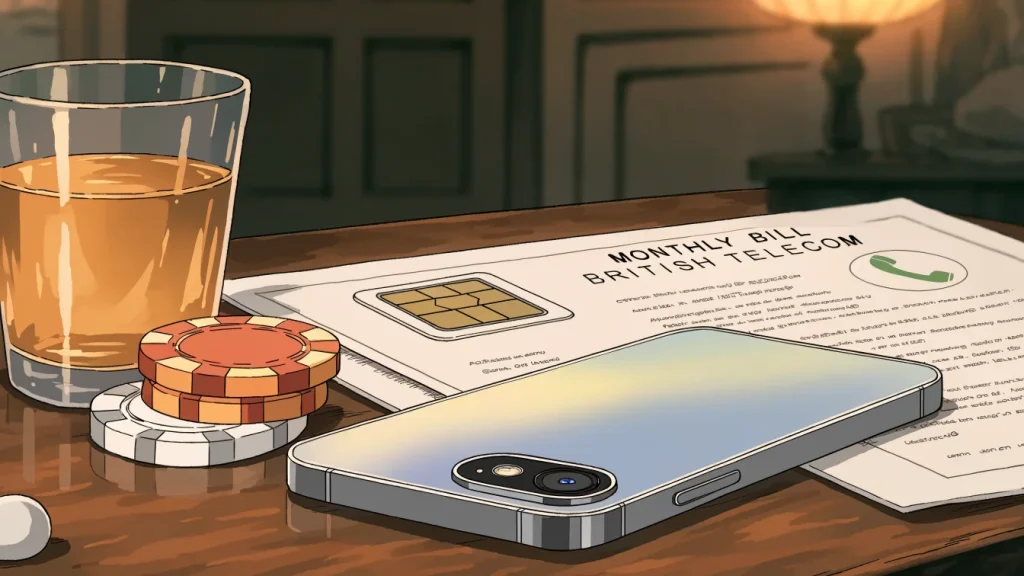
Payforit can charge a contract bill or reduce prepaid phone credit, depending on how the mobile account is funded.
Why a Phone Bill Can Fund a Casino Account
Paying by phone bill gives a casino account a place in an existing mobile-payment arrangement. In the UK, the name associated with this route is Payforit. It is generally reserved for mobile players, and the key distinction is not between one kind of casino and another, but between the ways a mobile customer pays for phone service: by monthly contract or with prepaid credit.
For a contract customer, a Payforit deposit is added to a future phone bill. The casino payment therefore appears alongside charges for the mobile service, rather than being taken from a bank card at the moment it is made. For a pay-as-you-go customer, the deposit comes out of prepaid credit already held on the phone. The two arrangements share the mobile connection, but they do not draw on the same pool of money.
That difference gives “pay by phone bill” a slightly misleading breadth. The phrase can sound as if every deposit is borrowed against a bill. That is true only for the contract version. With pay-as-you-go, the relevant balance has already been paid for; a deposit reduces that balance. In either case, the mobile account is the source through which the payment is carried. It is not simply a casino deposit that happens to be made on a phone screen.
The distinction matters because the timing of a charge and the origin of the money are separate questions. A contract customer sees the amount added to a bill that arrives later. A pay-as-you-go customer uses credit that is already available. Neither description changes what the payment is for: funds are being put into a casino account. What changes is where the charge sits in the customer’s ordinary mobile spending.
This is one reason Payforit is best understood as a mobile-focused route rather than a general payment choice for every device and account. Its connection to a mobile account is central to how it works. A desktop user may be able to access a casino site, but that does not make Payforit a desktop-oriented payment method. The route belongs to the mobile side of the payment landscape, where the phone account can carry either a later-billed charge or a deduction from prepaid credit.
Instant Bank Transfer Casinos in the UK: Payment Guide
The arrangement also reflects a familiar feature of household finance: expenses are divided not only by what they buy, but by when they become visible. A monthly contract gathers charges into a bill for later payment. Prepaid service asks for money in advance and then draws down the available balance. Payforit follows that underlying distinction rather than erasing it. The same casino deposit can therefore appear in two different financial contexts, depending on the mobile plan.
That can make the phrase “mobile phone bill casino” sound more uniform than the reality. A deposit charged to a monthly bill and one taken from prepaid credit are not identical in their effect on a customer’s finances. The contract customer has an additional amount to account for when the bill is due; the pay-as-you-go customer has less credit left for other mobile use. Neither route turns the casino balance into phone credit, or phone credit into a casino account. They remain separate balances connected by a payment.
Payforit’s mobile focus should not be confused with a promise that every mobile casino accepts it. The payment route and the casino’s own available options are different matters. Nor does being able to open a casino on a mobile device establish that a phone-billed deposit is available there. The distinction is simple, but easy to lose when “mobile casino” is used to describe both the device used for play and the source of the deposit.
In plain terms, a pay-by-mobile deposit takes its funding from the customer’s mobile arrangement: a future bill for a contract phone, or prepaid credit for a pay-as-you-go phone. That is the useful starting point for understanding Payforit. One charge appears later; the other reduces what is already there. No mystery.
Finding Payforit in a Casino Cashier
Payforit is not a universal fixture of UK casino cashiers. Its presence depends on the operator, and a payment option mentioned in an older review or guide may no longer appear when an account is opened. The live cashier is the practical test: it shows which methods the operator currently makes available to that account.
Payforit availability depends on the operator. Always check the live cashier to confirm if it is currently an option for your account.
A specialist review has reported Payforit among the cashier options at Kwiff, NetBet, JackpotJoy and Virgin Games. Those names are examples, not a ranking or a guarantee of present availability. Payment menus can change, and an option may be visible to some customers but not others. Before treating any casino as a place to pay by phone bill, the current cashier and the operator’s UKGC licence status need to be checked together.
That distinction matters in Britain’s regulated market. A casino serving customers in England, Scotland and Wales must hold the relevant UK Gambling Commission licence; a familiar name or a payment logo is not proof of that status. The cashier establishes what the account can use. The licence establishes whether the operator can lawfully offer gambling to customers in Great Britain. They answer different questions.
The menu itself may be reached through an account’s deposit or payment area, but its labels and layout belong to the operator. Payforit may be grouped with other deposit methods, or may not be displayed at all. A page describing a casino’s payment options is useful only as a lead: it cannot replace the live account view, particularly when the information concerns a method whose availability can change.
There is little value in relying on a general claim that a casino accepts phone-bill deposits. “Pay by phone” can be used loosely in promotional copy, while the actual cashier names the specific service. The relevant label is Payforit. If the cashier does not show it, a third-party article or an old screenshot does not make it available. Nor does the presence of Payforit at one operator establish that another operator in the same group offers it.
Before depositing, the cashier should be read as a set of account-specific terms, not merely a row of logos. Check the displayed minimum deposit, maximum transaction value and any fee, along with the account’s financial-limit controls. These details can depend on the operator and selected method, so figures copied from another casino may not apply. A specialist review can help identify what to look for, but the live cashier is the place to confirm the current conditions.
£1 Minimum Deposit Casinos in the UK: What to Know
There is also a required pause for new remote customers. Before a first deposit, the operator must prompt a new customer to consider setting a financial limit; account-level limit facilities must remain accessible afterwards. That prompt is part of the deposit environment, not an optional extra attached to one payment brand. A cashier that presents payment choices without making the relevant controls accessible would not give a complete picture of the account.
A careful check therefore has several parts: confirm Payforit is actually listed, confirm the operator’s UKGC licence, and read the current deposit and limit information shown for the account. These checks do not turn a changing cashier into a permanent catalogue. They simply separate a reported example from a usable option.
This is especially important when looking for a new pay-by-phone casino. “New” may describe a recently published review rather than a newly introduced cashier option, and a review’s wording can outlast the payment arrangement it describes. The operator’s own live cashier carries more weight than a date-stamped recommendation. If Payforit is absent there, the sensible reading is absence—not an invitation to infer support from another site’s experience.
The cashier is less glamorous than the promise of a frictionless deposit. It is also more useful: it shows whether Payforit is available now, for that account, under the operator’s current terms. A logo elsewhere is only a report.
The SMS Confirmation Behind a Payforit Deposit
A Payforit deposit begins in the casino’s cashier, where the payment method is selected. The next step is to enter a mobile number. Payforit then sends a confirmation code by text; submitting that code authorises the deposit. The sequence is deliberately simple, but each part has a distinct role: the cashier sets up the request, the number identifies the phone account to be charged, and the code confirms that the transaction is being approved through that phone.
£2 Minimum Deposit Casinos in the UK: What to Know
That text is not the money arriving. It is the authorisation step. Until the code is submitted, the deposit has not completed through the process described here. A mobile number alone does not stand in for consent; the confirmation code is the point at which the phone user approves the payment. This separates choosing a payment method from agreeing to a particular charge.
The distinction matters because a casino account and a phone account are not the same purse. Payforit links them for the transaction, but the money is taken from the phone service rather than from a bank card entered in the casino cashier. The route depends on how the mobile service is paid for: a monthly contract customer has the charge added to a future phone bill, while a Pay as you Go customer uses prepaid balance.
In other words, the casino balance is funded through the mobile account’s billing arrangement. The deposit does not become a separate phone call or a message charge merely because a text is involved. The SMS carries the confirmation code; the payment itself is charged to the bill or prepaid credit associated with the number.
That division can be easy to miss when the whole process takes place on a phone screen. The casino shows a deposit request, the phone receives a message, and the account balance changes after confirmation. Yet the casino is not collecting the cost through the text message itself. The message is part of the approval mechanism; the phone bill or Pay as you Go balance is the source of funds.
A careful sequence therefore has a plain logic:
- Payforit is chosen in the casino cashier.
- The mobile number for the payment is entered.
- A confirmation code arrives by SMS.
- The code is submitted to authorise the deposit.
- The charge is assigned to the relevant phone billing account or prepaid balance.
Each stage depends on the previous one. If the number entered is not the one intended for the transaction, the approval message may go to the wrong handset or account. If the code is not submitted, the confirmation step has not been completed. The procedure is not complicated, but it is tied to the particular mobile account involved.
This explains why “casino deposit by phone bill” is more than a label in a cashier. It describes a path from a casino payment request to a mobile account, with an SMS confirmation between them. The phone serves two functions at once: it receives the code used to approve the transaction, and its billing arrangement supplies the funds. On a contract, the charge appears on a future bill; with Pay as you Go, it comes from prepaid credit.
There is a small social history in that arrangement. Mobile phones were built around the idea that a service could be charged to a household bill or drawn from credit already loaded onto a handset. Payforit carries that familiar billing relationship into an online casino. It does not make the transaction invisible: the SMS interrupts the flow and asks for confirmation. A modest piece of friction.
Payforit Deposit Process
Step 1
Select Payforit in the casino cashier.
Step 2
Enter your mobile number.
Step 3
Submit the confirmation code received via SMS.
The method is also distinct from typing payment-card details into the cashier. The phone number and SMS code form the authorisation path described by Payforit, while the charge is carried by the mobile account. That does not mean every mobile deposit works this way, nor that a text message alone is evidence that a payment has been accepted. The relevant action is submitting the confirmation code within the Payforit process.
For a customer trying to understand a phone-billed casino deposit, the essential point is the source of the funds and the role of the text. The code approves the request; it does not pay it. The monthly bill or prepaid balance does.
The Small Ceiling on Phone-Billed Deposits
Payforit is a small-scale way to put money into a casino account, and its limits are part of the method rather than a detail to discover after choosing it. A specialist review gives a commonly reported deposit range of £3 to £5 at the lower end, with £30 as the upper end. The precise minimum can differ between cashiers, so that range is a guide to what has been reported, not a promise that every operator will accept the same amount.
£3 Minimum Deposit Casinos in the UK: What to Know
The upper figure has a firmer basis: the phone-paid services regulator sets a £30 ceiling for each Payforit transaction. That makes the method ill-suited to a large deposit in a single payment. The cap applies to the individual transaction; it is not an assurance that a casino will accept deposits at the ceiling, or that its own minimum and maximum will match the wider rule. The cashier’s current terms remain the point at which those operator-specific conditions become clear.
There is a certain plainness to this arrangement. A phone-billed deposit is not a blank cheque hidden among the monthly charges, but a tightly bounded purchase. That may make Payforit a practical option for someone keeping a deposit modest, while making it a poor fit for anyone expecting the payment route to accommodate a larger transfer. Small by design.
The cap should not be confused with a personal spending control. It limits the size of a single transaction; it does not decide how much a person can afford to spend across an account or over time. Those are different questions, and British rules require the operator to raise the latter before gambling begins.
New remote customers must be prompted to consider setting a financial limit before making their first deposit. This prompt is not an optional courtesy, nor does the presence of a transaction cap take its place. The two controls work at different levels: one concerns the permitted size of a Payforit payment, while the other gives the customer a way to set an account-level boundary. Limit-setting facilities must also remain accessible after that first deposit, rather than disappearing once the initial prompt has been dealt with.
The distinction matters because a small payment can still be part of spending that adds up. A £30 transaction ceiling says nothing about a player’s own budget, and a personal limit does not alter the amount permitted in an individual Payforit transaction. The safeguards are not interchangeable. The first is attached to the payment method; the second belongs to the account and the decisions made around it.
£4 Minimum Deposit Casinos in the UK: What to Know
Promotions add another qualification. Specialist reviews report that most UK casinos exclude Payforit deposits from welcome bonuses and other promotional offers. That is a reported pattern, not a universal term: the wording of an offer and the operator’s current rules determine whether a particular deposit qualifies. Where the payment method is excluded, the deposit may still reach the casino balance, but it will not meet the promotional condition. The offer’s terms should be read before relying on a bonus being attached.
That separation can seem counterintuitive. A deposit may be accepted for ordinary play while being ineligible for a promotion. The cashier’s acceptance of Payforit, therefore, does not itself establish that a welcome offer applies. Promotional terms can define eligible payment routes independently of the method’s availability, and a headline offer is no substitute for checking those conditions.
For a UK casino account, then, Payforit’s defining constraint is not merely the small transaction ceiling. It sits alongside a variable operator minimum, possible promotional exclusions and a separate obligation to consider an account-level financial limit before the first deposit. The method can make a modest payment possible; it cannot make that payment larger than its cap, guarantee bonus eligibility or stand in for a customer’s own spending boundary.
What Accepting Phone-Bill Deposits Does—and Does Not—Mean
Payforit is one way to fund a casino account, not a quality mark for the casino or a promise that every payment route will be available. A casino that accepts phone-bill deposits may also offer other methods, but the options belong to the operator’s live cashier, not to the idea of “pay by phone” as a whole.
Boku, e-wallets and Paysafecard are alternatives identified in specialist casino reviews. They are not interchangeable. Boku is another pay-by-mobile route; an e-wallet holds funds in an account outside the casino; Paysafecard is a prepaid option. Each brings its own conditions, and availability needs to be checked at the casino itself. A method mentioned in a review may not appear for every account or remain available as the cashier changes.
Debit cards occupy a different position. A specialist review of UK casinos describes debit-card deposits as free and more widely accepted than Payforit, but fees and accepted methods are operator-specific. The cashier is the place to establish what applies to a particular account. Breadth of acceptance matters: a phone-bill option can be useful where it is offered, yet it is not a substitute for checking which alternatives are actually enabled.
Attention UK Gambling Commission rules prohibit licensed remote operators from accepting credit-card payments for gambling.
Credit cards are different again, because the restriction is regulatory rather than a matter of cashier preference. UK Gambling Commission rules prevent remote gambling licensees from accepting credit-card payments for gambling. The prohibition also covers a payment routed through a money service business, so moving the funds through an intermediary does not make a credit card an acceptable source for a casino deposit.
That boundary reflects a policy choice about how gambling is funded. A debit card draws on available money in a bank account; a credit card borrows against a lender’s promise. The distinction is not merely technical. British rules do not permit licensed remote operators to take credit-card payments for gambling, even when the route is dressed in another financial layer.
For people comparing casino sites that accept phone-bill deposits in the UK, the useful comparison is therefore between methods that the current cashier actually displays: Payforit alongside any available Boku, e-wallet, Paysafecard or debit-card option. A casino app does not change the underlying payment rules. Its cashier still determines which methods can be used, while the credit-card ban applies regardless of whether a deposit begins on an app or a website.
More choice is not the same as a better fit. Payforit’s role is specific; alternatives have different arrangements, and credit cards are outside the permitted set for online casino gambling in Great Britain. The distinction is plain enough. Not every route is a route.
£5 Minimum Deposit Casinos in the UK: What It Means
A Deposit Method Is Not a Payout Method
Payforit moves money into a casino account; it does not provide a route for taking winnings back out. The phone bill or prepaid balance can fund a deposit, but casino funds cannot be withdrawn through Payforit. That difference is easy to miss when both actions sit under the same cashier heading. The menu is shared; the payment routes are not.
A separate, verified payout method may therefore be needed. Specialist reviews of UK-licensed casinos identify debit cards, bank transfers, PayPal and e-wallets such as Skrill or Neteller among possible withdrawal routes. That is a description of options reported across operators, not a promise that each will appear for every account. Availability depends on the casino’s current terms and cashier, and the account holder’s details and currency must match the chosen route.
The distinction matters before a deposit, not merely when a balance is ready to leave. A casino may require identity checks to be completed before processing a withdrawal, and a method visible to one customer may not be available to another. The cashier and the operator’s current terms are the practical reference points; a payment brand’s general availability says little about a particular account.
For a Payforit deposit, the withdrawal plan should include a verified destination such as a bank account, debit card, e-wallet or another payment source accepted by the operator. This is not a way to reverse the phone charge. It is a separate transaction, subject to its own checks and conditions. The route, account details and currency should all be compatible before money is added.
Important Distinction
Payforit is a method for depositing funds into a casino, not a method for withdrawing winnings.
Independent specialist reviews also warn that payout arrangements can differ between operators and change over time. A listed method is not a standing entitlement. The cashier may set its own withdrawal conditions, while unfinished identity checks can delay access to funds. It is worth treating the payout information as part of the deposit decision rather than as an administrative detail for later.
Phone-billed deposits have a clear endpoint: the casino account. Getting funds out is a different matter, with its own route and verification. A small but consequential distinction.
Phone-Billed Deposits and Slot Play
A phone-billed deposit does not attach a payment method to an individual slot. Payforit, where an operator offers it, puts funds into the casino account; games are then played from that balance. The distinction is easy to lose in phrases such as “slots paid by phone”, but the slot itself does not take a charge from a mobile account each time it is opened or played.
That separation matters when looking for phone-bill slots in the UK. A game’s presence in a casino does not establish that Payforit can fund the account, and a Payforit option in the cashier does not certify that every game has identical terms. Payment access belongs to the operator’s account and cashier arrangements; game access is a separate matter.
Before depositing, the live cashier is the place to check the current minimum deposit, maximum transaction value and any fee. It should also show the account’s financial-limit controls. These details can differ between operators and may change, so a remembered cashier screen is not a reliable guide to the present one.
Casinos That Accept Pay N Play in the UK
There is a broader point about how gambling is organised online: money enters through an account, while play is divided into individual games. The payment label can therefore suggest a closer connection than actually exists. A phone-bill deposit is not a special class of slot, nor does it mean a particular game can be bought directly through a mobile network.
For new remote customers, the operator must prompt consideration of a financial limit before the first deposit. Limit facilities must remain available afterwards, rather than appearing only at registration and disappearing once the account is active. Checking those controls alongside the cashier’s deposit terms gives a clearer picture of what the account permits than a game label can provide.
The distinction is practical, not merely technical: the relevant question is whether the casino account accepts the chosen payment route and what controls apply to that account. Slot titles alone cannot answer it.
Network Fees and Phone-Bill Compatibility
A casino’s payment page and a mobile network answer different questions. The cashier determines whether Payforit is offered for that account; the network’s terms determine whether a phone-billed transaction can be processed and whether a charge applies. A Vodafone or giffgaff customer cannot infer support from the network name alone. Availability needs confirmation in the casino’s current cashier, while any network-specific restrictions or charges need checking against current network information.
The distinction matters because a payment option can be present at an operator without being suitable for every mobile connection. Network arrangements, account type and tariff may affect compatibility. A specialist payment review describes Boku processing fees as potentially varying between networks and tariffs. That is a reason to check the details attached to the particular transaction, not evidence that Vodafone or giffgaff charges a fee, or that either network is accepted by a given casino.
Transaction limits and network fees are separate; the £30 Payforit ceiling is a fixed regulatory cap per transaction.
Nor should a possible fee be confused with Payforit’s transaction ceiling. Phone-payment regulatory guidance sets a £30 maximum for a Payforit transaction. That cap is a fixed boundary on the transaction amount; a network fee, where applicable to a service, is a separate charge whose amount may depend on network and tariff. The two should not be treated as interchangeable, or combined into an assumed price.
Before confirming a phone-billed payment, the cashier should make clear what it proposes to charge and whether the selected method is available for the account. If the display does not explain a fee, the network’s current tariff information may clarify it; if the method itself is absent, a search for the network name cannot substitute for operator confirmation. The practical answer is specific to the live payment route, not to the logo on the handset. A small distinction, with real consequences.
Topping Up an Account Without Exceeding the Cap
A Payforit top-up is a casino deposit, not a way around the payment limit. The phone-paid services rules set a ceiling of £30 for each transaction. Splitting a larger intended deposit into successive payments should not be treated as a permitted workaround: each payment remains subject to the cap and to the operator’s own controls.
The amount that can actually be deposited may be lower. Before proceeding, the live cashier is the place to check the operator’s current minimum and maximum, any fee, and the financial-limit controls attached to the account. Those details can differ between operators and may change, so an old review or a saved payment screen cannot establish the terms of a new transaction.
This matters particularly where a cashier sets a maximum below the phone-paid transaction ceiling, or where a minimum deposit and any fee affect the amount charged. The displayed terms should be read together rather than treating the £30 cap as a promise that every deposit of that size will be accepted.
New remote customers must also be prompted to consider a financial limit before making their first deposit. That prompt is not a technicality to step around while topping up: account-level limit facilities must remain accessible afterwards.
A top-up is therefore bounded twice over: by the phone-payment cap and by the casino account’s current settings. The cashier decides what it will accept.
Boku, Three and the Need to Check the Cashier
Boku and Payforit are separate payment names, not interchangeable labels for every pay-by-phone option. A casino cashier may offer one, both or neither; the presence of Boku elsewhere does not establish that it is available at a particular operator. The same applies to Three: its customers should not assume that a casino accepts Boku through that network unless the live cashier confirms it.
When Boku is offered, the transaction requires an SMS confirmation before funds move. The phone credit or bill allowance must also cover the deposit and any network processing fee. That fee can vary with the network and tariff, so the amount shown during payment matters more than a general description of the service. If the available balance cannot cover the full charge, the payment may not go through.
A specialist review describes Boku’s per-transaction ceiling as £30. That is a stated cap, not a reason to divide a larger intended deposit into repeated payments; the cashier’s displayed limits and the rules for the account still apply. Fees, minimums and maximums should be checked at the point of deposit, since payment terms can change.
Payforit has its own confirmation and charging arrangements, so a familiar phone-billed process should not be taken as proof that Boku works identically. In particular, Three support cannot be inferred from the operator’s name or from another casino’s payment page. The cashier is the test. Plainly so.
Why did my Payforit deposit fail at a UK casino?
Your phone credit may not cover both the deposit and any network fee, or the SMS confirmation may not have been completed. Payforit is also generally limited to mobile use.
What is the maximum I can deposit with Boku at a UK casino?
Boku deposits are capped at £30 per transaction.
Do UK casinos offer welcome bonuses for Payforit deposits?
Usually not: most UK casinos exclude Payforit deposits from welcome bonuses and other promotions.
How does Payforit work at a casino deposit?
Select Payforit in the casino cashier, enter your mobile number, then submit the confirmation code sent by SMS. The deposit is charged to your contract phone bill or deducted from your pay-as-you-go credit.
Are there fees for using Boku at online casinos?
A mobile network may charge a processing fee, and the amount varies by network and tariff. Check the current cashier and your network’s terms before depositing.
Can I use Boku on a pay-as-you-go phone?
Yes. The phone credit must cover the deposit and any network fee, and you must confirm the transaction by SMS.
Do online casino bonuses work with Payforit deposits?
Usually not: most UK casinos exclude Payforit deposits from welcome bonuses and promotional offers.