
Bankroll Management for Slots
 Available in GB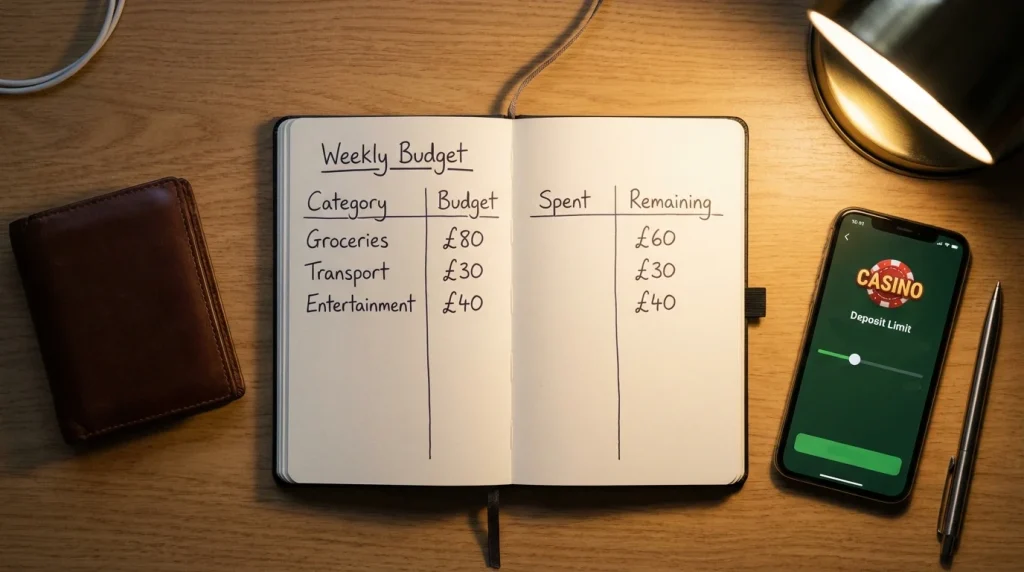
Your Budget Is Your First Decision
Bankroll management starts before the first spin — not after the first loss. The most consequential moment in any slot session is not when the bonus round triggers or when a big win lands. It is the moment you decide how much money to bring to the table. Everything that follows — how long you play, how much you bet, when you stop — flows from that single decision. Get it right and the session stays within your control. Skip it and you are improvising with real money, which is another way of saying you have no plan at all.
Bankroll management is not a strategy for winning. Slots carry a house edge that no budgeting system can overcome. What bankroll management does is limit how much you lose, extend the entertainment you extract from your budget, and prevent the kind of impulsive decisions that turn a recreational session into a regrettable one. It is the least exciting and most useful skill a slot player can develop.
Setting a Session Budget You Can Afford to Lose
The session budget is money you have already mentally spent. This framing matters because it changes how you relate to the money once it is in play. If you deposit £50 and treat it as money you might get back, every losing spin feels like a loss. If you deposit £50 and treat it as the cost of tonight’s entertainment — the same way you would view a cinema ticket or a restaurant bill — then the session becomes what it is: a paid experience with a variable duration, not an investment with an expected return.
The arithmetic for setting a session budget is personal, but the principle is universal: the budget must come from discretionary income, after all obligations are met. Rent, bills, groceries, savings, debt payments — none of these should be reduced to fund a slot session. The budget is what remains after the non-negotiable expenses are covered. If nothing remains, there is no session this week. That is not a failure of discipline; it is discipline working as intended.
A weekly or monthly gambling budget, divided into individual sessions, is more effective than deciding on the fly. If you allocate £100 per month for slots and play four sessions, each session gets £25. That number is fixed before you open the casino. It does not increase because the previous session went well. It does not decrease because you feel guilty about last week’s loss. It is a line item in your entertainment budget, and it behaves like one.
One practical step that reinforces the budget: deposit only the session amount. If your session budget is £25, deposit £25. Do not deposit £100 with the intention of stopping at £25, because the remaining £75 in your account becomes a standing temptation the moment the £25 is gone. The deposit itself should be the boundary, not your willpower.
Bet Sizing: How Much Per Spin
One to two percent of your session budget per spin keeps you in the game longer. Bet sizing is the mechanism that translates your session budget into a number of spins, and the number of spins determines how long your session lasts and how much of the game’s design you actually experience.
At 1% of a £25 budget, your stake is £0.25 per spin, giving you 100 spins before the budget is exhausted (assuming no wins return anything to the balance). At 2%, the stake is £0.50, and you have 50 spins. Low-volatility games at 1% give the longest sessions; high-volatility games at 2% give the shortest. The trade-off is between duration and per-spin win potential — smaller stakes produce smaller wins, but they buy you more time in the game.
A useful guideline: aim for a minimum of 200 spins per session. On a low-volatility slot, this is comfortable at 1% per spin. On a medium-volatility slot, 1.5% provides a balance between spin count and meaningful payouts. On a high-volatility slot, even 2% may feel tight, because the dry stretches between wins are long enough that your balance can deplete before a feature triggers. If the maths does not support 200 spins at your preferred volatility, either lower the stake or choose a less volatile game.
Resist the temptation to escalate bet size mid-session. A common pattern: the player starts at £0.25, loses a third of their budget, and doubles the stake to £0.50 to “recover.” This halves the remaining session length and doubles the rate of loss during dry spells. The instinct to recover feels rational, but the maths does not support it. Each spin is independent; increasing the stake does not improve your probability of winning. It only increases the speed at which you deplete whatever remains.
Win Limits, Loss Limits, and When to Walk Away
Set a loss limit and honour it — no exceptions. A loss limit is the maximum amount you are willing to lose in a single session. For most players, this should equal the session budget: when the deposit is gone, the session ends. No top-ups, no “just one more deposit,” no rationalisation that the game owes you a bonus round. The loss limit is the boundary, and crossing it is the definition of losing control.
Win limits are more nuanced. A win limit is the point at which you stop playing and withdraw, regardless of how the session is going. If you start with £25 and set a win limit of £50 (double your buy-in), you stop and cash out when your balance reaches £50. The logic is that continuing to play after a significant win exposes those winnings to the house edge, and over time, the maths will reclaim them. Withdrawing locks in the gain.
The challenge with win limits is psychological. A session going well feels like it should continue. The impulse to “let it ride” or “see what happens” is strong because the winning state produces dopamine, optimism, and a distorted sense that the streak will persist. It will not — the RNG does not know or care that you have been winning — but the feeling is persuasive. A pre-set win limit removes the decision from the moment and anchors it in the calm judgment you exercised before the session started.
The hardest rule is also the simplest: when you hit either limit, stop. Close the game. Log out of the casino. Do something else. The limits have no value if they are negotiable. Every time you override a limit — “I’ll just play five more minutes,” “I’ll just use the win, not the original deposit” — you are dismantling the system that protects you. The system works exactly as well as your commitment to it.
For players who find adherence difficult, the next section offers a mechanical solution. But be honest with yourself first: if you cannot respect a limit you set voluntarily, the limit was either set too aggressively (lower it until it is realistic) or you need the kind of external enforcement that software provides and willpower cannot.
Using Casino Tools to Enforce Discipline
Deposit limits and session timers do the enforcing when willpower does not. Every UKGC-licensed casino offers responsible gambling tools that function as automated bankroll controls. They are not optional extras — they are built-in features designed for exactly the scenario where your in-the-moment judgment fails. The UKGC requires operators to provide these player protection measures as a condition of their licence.
Set a deposit limit that matches your weekly or monthly gambling budget. If your budget is £100 per month, set the monthly deposit limit to £100. Once reached, the system blocks further deposits regardless of your state of mind. Set a session timer for the length of time you intend to play. When it triggers, it interrupts the game and gives you a decision point — continue or stop — in a moment of enforced clarity.
These tools are most effective when configured at the time you create your account, before you have played a single spin. Adjusting them later is possible, but reducing a deposit limit takes effect immediately while increasing one requires a mandatory cooling-off period (typically 24 to 72 hours). This asymmetry is deliberate: it is easy to tighten your controls and difficult to loosen them, which is exactly how a protective system should work.
Discipline Is Not Glamorous, But It Is Free
The best bankroll strategy costs nothing and saves everything. No deposit limit, session timer, or budgeting spreadsheet will turn a negative-expectation game into a profitable one. What they do is ensure that the cost of playing stays within the range you defined as acceptable before emotion, adrenaline, and the mechanics of slot design had a chance to influence your decisions.
Set the budget. Choose the stake. Define the limits. Use the tools. Then play. The system is not complicated. The difficulty is not in understanding it — it is in following it on the evening when your balance is dropping and the bonus round feels one spin away. That is the evening the system was built for.