
Live Casino vs Online Slots
 Available in GB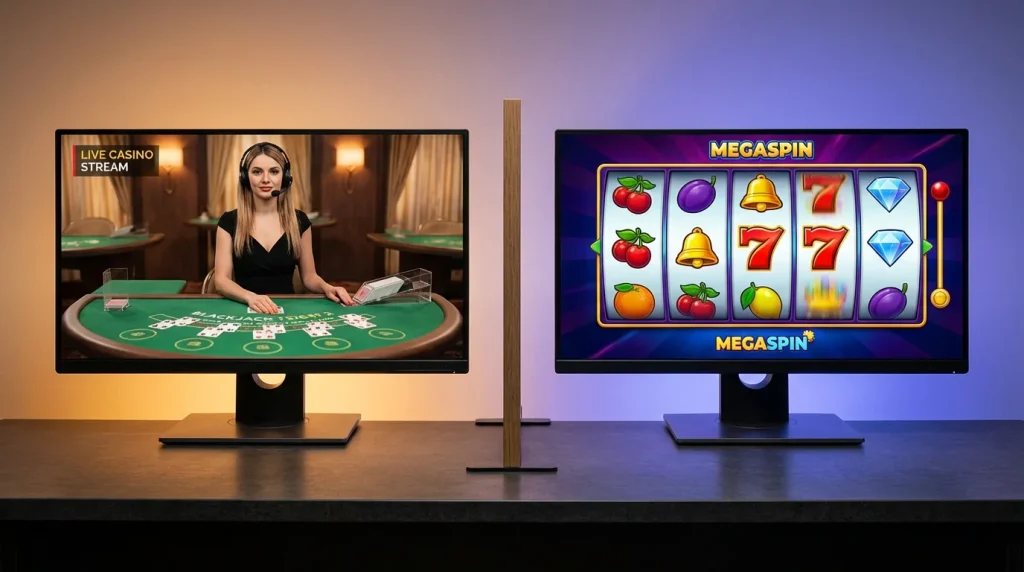
Two Different Games Under One Roof
Live casino and slots share a platform but almost nothing else. They sit in the same casino lobby, they are funded from the same player balance, and they are regulated under the same UKGC licence. Beyond those surface-level connections, they are fundamentally different products — different in pace, in mathematics, in social dynamics, and in the kind of experience they offer. Choosing between them is not about which is better but about what you are looking for from your session.
Most UK casino players default to one format or the other based on habit. Understanding the structural differences between the two — how the house edge compares, how fast your bankroll moves, and what type of engagement each provides — lets you choose deliberately rather than reflexively.
Online Slots — Solo, Automated, Volatility-Driven
Slots are a private, fast-paced, RNG-determined experience. You play alone. The game is automated. Each spin takes a few seconds, and the result is decided by a random number generator the instant you press the button. There is no dealer, no other players at the table, and no social dimension whatsoever. It is you, the screen, and the mathematics.
The pace of slot play is considerably faster than live casino games. A typical video slot session runs at 400 to 600 spins per hour, depending on the game’s animation speed and whether you use turbo or autoplay features. Each spin resolves in seconds, which means the game’s maths operates at high frequency — hundreds of independent trials per session, each extracting the house edge from your wager.
Volatility is the defining characteristic of the slot experience. The range of possible outcomes on any given session is vast: you might lose your entire budget in 20 minutes, or you might hit a bonus round that returns 200 times your stake. This variance is inherent to the format and is the primary source of both its entertainment value and its risk. You cannot influence the outcome through skill, strategy, or decision-making during play. The only variables you control are game selection (RTP, volatility), bet sizing, and when to stop.
RTP on slots typically ranges from 90% to 99%, with most UK casino lobbies clustering between 94% and 97%. The house edge is built into the game’s mathematical model, certified by independent testing labs, and — in theory — disclosed within the game’s info screen. Variable RTP builds mean the actual return can differ between casinos for the same title, a practice documented across major providers such as Nolimit City and Pragmatic Play.
Live Casino — Social, Dealer-Led, Real-Time
Live games add a human element: real dealers, real cards, real-time results. Live casino games are streamed from professional studios (or occasionally from physical casino floors) to your device, with a real human dealer managing the game in real time. You see the cards dealt, the wheel spun, or the dice thrown via video feed, and you place bets through a digital interface overlaying the stream.
The social dimension is the most visible distinction from slots. Live casino tables often accommodate multiple players simultaneously, and many include a chat function where participants can interact with the dealer and each other. The dealer’s personality, the pace of their dealing, and the presence of other players create a social atmosphere that slots, by design, do not offer.
The pace is dramatically slower than slots. A live blackjack hand takes 30 to 60 seconds. A live roulette round runs on a cycle of approximately 60 to 90 seconds between spins, including betting time. In a typical hour, you might play 60 to 80 blackjack hands or 30 to 40 roulette rounds — a fraction of the spin count you would accumulate on a slot in the same timeframe. This slower pace means the house edge operates at lower frequency per hour, which affects how fast your bankroll moves.
Decision-making is a factor in some live casino games. Blackjack, in particular, involves strategic choices — hit, stand, double, split — that directly affect the expected return. Optimal blackjack strategy reduces the house edge to approximately 0.5%, making it one of the lowest-edge games available at any UK casino. Roulette and baccarat, by contrast, are pure chance with no meaningful strategy: you place your bet and watch the outcome, much like a slot spin with better visuals.
House Edge, Pace, Stakes, and Social Factor Compared
Slots run faster; live games offer lower house edge on some titles. The comparison between the two formats is clearest when broken down across the dimensions that matter most to your session experience.
On house edge, live casino games generally offer better mathematical value on a per-bet basis. Blackjack with optimal strategy runs at approximately 0.5% house edge. European roulette sits at 2.7%. Baccarat (banker bet) is around 1.06%. Compare these to the typical slot at 4% to 6% house edge (96% to 94% RTP), and the per-bet cost of live games is substantially lower. However, per-bet cost and per-hour cost are different calculations, which leads to the next dimension.
On pace, slots extract the house edge much more frequently. At 500 spins per hour on a slot with 4% house edge and a £1 stake, the expected hourly cost is £20. At 70 hands per hour on blackjack with 0.5% house edge and a £5 minimum bet, the expected hourly cost is £1.75. Even with a higher per-hand stake, the slower pace and lower edge make live blackjack cheaper per hour of entertainment. Live roulette at 35 rounds per hour with a £2 bet and a 2.7% edge costs approximately £1.89 per hour. The per-hour comparison favours live casino games for players who measure value in entertainment time per pound spent.
On stakes, live casino tables typically require higher minimum bets than slots. A live blackjack table might have a £5 or £10 minimum, while many slots accept bets as low as £0.10 or £0.20. This higher entry point means live casino games are less accessible for players with very small session budgets. A player with £10 to spend can play 50 to 100 slot spins but might afford only one or two live blackjack hands.
On the social factor, the comparison is binary. Slots are solitary; live games are communal. If you value interaction, atmosphere, and the presence of a human dealer, live casino provides something that slots cannot. If you prefer privacy, speed, and the ability to play without social engagement, slots are the natural fit.
Which Format Fits Your Play Style?
Choose based on what you value: speed, social interaction, or edge. Neither format is superior — they serve different purposes and appeal to different motivations.
Choose slots if you want fast, private play with a wide range of volatility options and the possibility (however unlikely) of an outsized win from a small stake. Accept that the house edge is higher per bet and that the pace will move your bankroll faster. Set strict limits, because the speed of play reduces the natural friction between decisions.
Choose live casino if you want slower-paced play with lower per-bet cost, a social atmosphere, and — in skill-based games like blackjack — the ability to influence the outcome through strategy. Accept that minimum stakes are higher, that the pace may feel slow compared to slots, and that the maximum win potential is far more constrained. No live blackjack hand will pay 10,000 times your bet.
Some players alternate between the two formats within a single session, using live casino for a slower opening period and switching to slots when they want faster action. If you do this, maintain a single session budget that covers both formats rather than allocating separate budgets that effectively double your total spend.
Different Experiences, Same Rule: Set a Budget
The format changes; the need for a limit does not. Whether you are spinning a slot at £0.50 per round or placing a £10 bet on a live roulette table, the principle is identical: decide how much you can afford to lose before the session starts, set a deposit limit that enforces it, and stop when the limit is reached. The house edge operates in both formats. The mathematics favour the casino in both formats. The only variable you control — in slots and in live casino alike — is how much of your money you expose to that edge.