Progressive Jackpot Slots UK
Best Non GamStop Casino UK 2026
Loading...
How a Jackpot Becomes Life-Changing
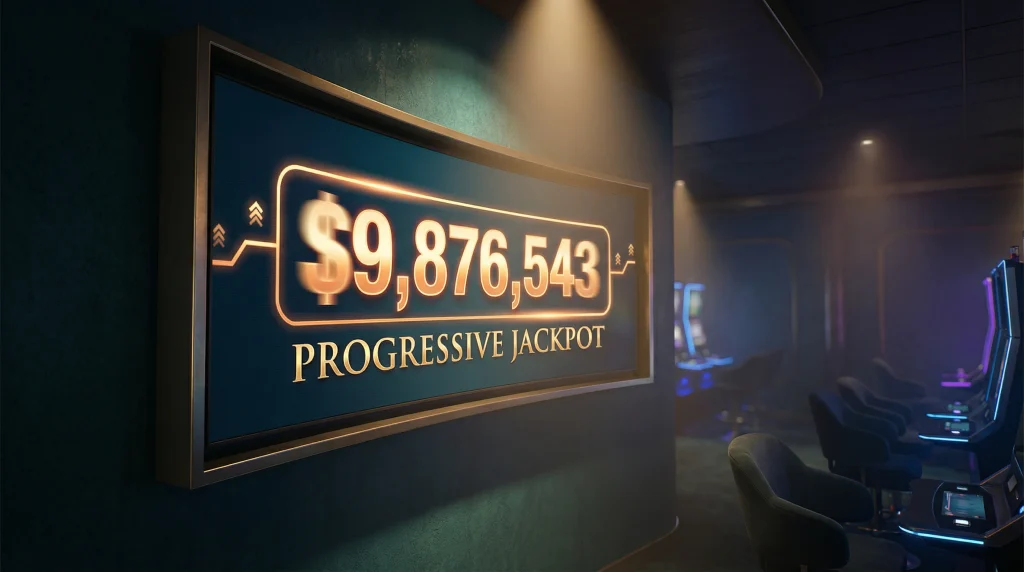
Progressive jackpots grow with every bet and pay out in a single spin. That one sentence explains both the appeal and the economics of the format. Unlike standard slots where the maximum win is a fixed multiple of your stake, progressive slots pool a fraction of every wager placed across the network into a central prize that climbs until someone triggers it. The pool resets, a new climb begins, and the cycle continues.
For UK players, progressive jackpot slots are available at virtually every UKGC-licensed casino. The games themselves are produced by major providers — Microgaming, NetEnt, Playtech, and others — and the jackpots can be linked across dozens of casino sites simultaneously. That cross-platform pooling is what allows prizes to reach six, seven, or occasionally eight figures. It is also what makes the odds of hitting one vanishingly small.
This article breaks down how progressive jackpots actually work at a mechanical level, which networks dominate the UK market, what the real odds look like, and what trade-offs you accept the moment you choose a progressive over a standard slot.
Pooled Prize Mechanics — Seeds, Contributions, Triggers
Every wager feeds the pool. One trigger empties it. The mechanics underneath that simple cycle are worth understanding before you start chasing seven-figure payouts.
A progressive jackpot starts with a seed value — the guaranteed minimum prize that the operator or network sets as the floor. When someone wins the jackpot and the pool resets, it resets to this seed, not to zero. Seed values vary by game: Mega Moolah, one of the most famous progressives, seeds at one million pounds. Smaller network progressives may seed at a few thousand.
From the moment the seed is set, every real-money bet placed on the linked game contributes a small percentage to the jackpot pool. This contribution rate is typically between 1% and 3% of each wager, though the exact figure varies by game and is built into the slot’s overall mathematics. That contribution is what makes the jackpot grow — and it is also what makes the game’s base RTP lower than equivalent non-progressive slots.
Consider a standard video slot with 96% RTP. A progressive version of a similarly structured game might run at 88–92% base RTP, with the missing percentage allocated to jackpot contributions. Some of that contribution goes to the main progressive prize, and smaller portions may feed secondary jackpots (mini, minor, major) that trigger more frequently but pay significantly less.
The trigger mechanism depends on the game. Some progressives use a random trigger — any spin at any stake can hit the jackpot, though higher bets typically improve the probability. Others require a specific bonus round to be activated first, with the jackpot awarded through a wheel spin or pick-and-click feature within that round. A few older games require maximum bet to be eligible for the top prize, though this design has become less common as regulators push for fairer stake-based access.
Once triggered, the jackpot pays out to the winning player, the pool resets to the seed value, and contributions begin accumulating again immediately. The speed at which the jackpot regrows depends entirely on how many players are wagering on linked games across the network at any given time — which is why the largest progressives are attached to the most widely distributed games.
UK Progressive Jackpot Networks and Record Wins
The largest UK progressive payout exceeded £13 million, won on Microgaming’s Mega Moolah network — a game that has paid out more cumulative prize money than any other progressive slot in history. Mega Moolah operates across a vast network of UKGC-licensed casinos, which is precisely why its jackpot climbs so quickly: thousands of players across dozens of sites feed the same pool simultaneously.
Microgaming’s progressive network remains the dominant force in the UK market. Beyond Mega Moolah, the company operates progressive jackpots on titles including Major Millions, King Cashalot, and the Mega Moolah series extensions. The network’s scale means its top-tier jackpots frequently reach eight figures before being won.
NetEnt’s Mega Fortune was for years the main competitor, and it still holds one of the largest online slot payouts ever recorded globally. The game’s three-tier jackpot system — Rapid, Major, and Mega — creates multiple prize levels, with the Mega jackpot triggered through a bonus wheel feature. Mega Fortune’s prize pool can grow into the millions, though it typically does not reach the heights of Mega Moolah due to a smaller player base.
Playtech operates the Age of the Gods progressive network, which links multiple themed slots to a shared four-tier jackpot. The network is well-represented at UK casinos, particularly those operating on the Playtech platform. Jackpots across the Age of the Gods series regularly pay out in the six-figure range, with the top-tier Ultimate Power jackpot occasionally crossing into seven figures.
More recently, Relax Gaming’s Dream Drop jackpot network has gained traction in the UK. Dream Drop uses a five-tier structure and has already produced several multi-million pound payouts since its launch. The network is integrated into various Relax Gaming and partner studio titles, spreading the contribution base across a growing catalogue of games.
Red Tiger’s Daily Jackpots deserve mention as well, though they operate differently. These are time-limited progressives that must pay out before a set deadline — usually once per day. The prizes are smaller, typically in the hundreds to low thousands, but the guaranteed drop makes them a distinct proposition from the open-ended accumulation model of Mega Moolah or Mega Fortune.
What Are the Real Odds of Winning a Progressive?
The odds are roughly equivalent to a lottery — with a house edge on top. That comparison is not hyperbole. The probability of triggering the top-tier jackpot on a game like Mega Moolah has been estimated at approximately 1 in 50 million spins, though exact figures are not publicly disclosed by the provider. What is clear is that these are extreme long-shot events, and treating them as anything else is a misunderstanding of how the format works.
To frame it practically: if you placed one spin every five seconds for eight hours a day, it would take you roughly 86 years of continuous play to reach 50 million spins. The jackpot does get won, of course, because thousands of players are spinning simultaneously across the network. But the individual player’s chance on any given session is negligible.
Lower-tier jackpots within progressive games have better odds. Mini and minor jackpots may trigger every few hours or days, paying out anywhere from tens to hundreds of pounds. These smaller prizes are baked into the game’s mathematics and contribute to the overall RTP alongside the main progressive contribution. But they are not why people play these games. The appeal is the headline number — the multi-million-pound figure on the ticker — and that prize sits behind extraordinarily long odds.
There is also a cost to chasing it. Because a portion of every wager feeds the jackpot pool, the base game returns less per pound wagered than a non-progressive slot with similar features. You are effectively paying a premium on every spin for a lottery ticket attached to the game. If the base RTP is 88% instead of 96%, you are losing an additional 8p per pound compared to a standard slot. Over hundreds or thousands of spins, that premium adds up to a meaningful difference in how quickly your bankroll depletes.
The Dream Is Built Into the Price
You pay for the possibility with a lower base RTP. That is the trade, and it is the only honest way to frame progressive jackpot slots. The format is not broken, it is not a scam, and the jackpots genuinely do pay out — sometimes to UK players, sometimes for life-changing amounts. But the premium is there on every spin, whether you notice it or not.
If you enjoy the format, play it with your eyes open. Set a session budget that reflects the faster bankroll erosion, view the ticker number as a bonus possibility rather than an expectation, and resist the urge to increase stakes in pursuit of a trigger that remains statistically indifferent to how much you bet. The entertainment value is real. The mathematics are equally real. Both can coexist if your expectations are calibrated from the start.