Slot Stake Limits in the UK 2026
Best Non GamStop Casino UK 2026
Loading...
New Caps, New Session Dynamics
The UKGC has capped online slot stakes, and the change affects how every session plays out. After years of industry consultation and regulatory review, the UK Gambling Commission introduced mandatory stake limits for online slots — one of the most significant structural changes to the UK gambling market since the credit card ban in April 2020.
The limits are simple in design but far-reaching in impact. They restrict the maximum amount a player can wager per spin, creating a ceiling that applies across all UKGC-licensed online slots regardless of the operator, the game provider, or the individual title. The intention is to limit the rate at which players can lose money, reducing gambling harm without removing access to the products entirely.
For casual players, the change may be imperceptible. For high-stakes players, bonus clearing strategists, and anyone who previously wagered at £10, £20, or higher per spin, the limits reshape session dynamics, bonus mathematics, and the practical experience of playing slots in the UK.
The Rules: £5 for Over-25s, £2 for 18 to 24
Stake limits are per spin, not per session — and they apply to all UKGC-licensed slots. The regulatory framework, detailed in the UKGC’s online slots stake limit guidance, sets two tiers based on the player’s age, which the operator determines through the mandatory Know Your Customer verification process completed at registration.
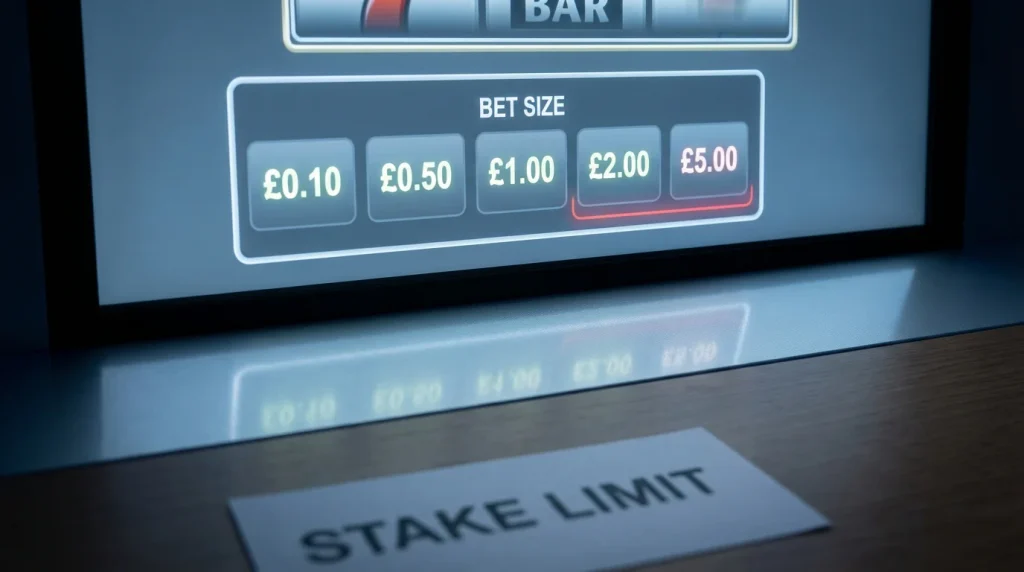
Players aged 25 and over are subject to a maximum stake of £5 per spin. Players aged 18 to 24 face a lower cap of £2 per spin. The age distinction reflects evidence presented during the UKGC’s consultation process indicating that younger adults are disproportionately vulnerable to gambling harm, with higher rates of problem gambling and lower average incomes than the over-25 demographic.
The limit applies to the total bet per spin, not to the base stake or the coin value. If a slot’s bet structure involves a base stake multiplied by the number of paylines, the total must not exceed the cap. A game with 20 paylines at £0.25 per line totals £5 — exactly at the limit for over-25 players. That same game would exceed the £2 cap for under-25s and would need to be played at a lower stake level.
For bonus buy features, the limit applies to the base stake on which the buy price is calculated, not to the total purchase cost. If the base stake is £2 and the bonus buy is 80x, the total purchase is £160 — which is permissible under the rules because the per-spin stake (the base bet) is within the cap. This interaction has drawn scrutiny, and further restrictions on bonus buy pricing relative to stake limits may follow.
The rules are enforced at the platform level. Game providers build the stake options into the software, and operators configure the maximum available bet in their lobbies to comply with the cap. Attempting to circumvent the limit — by opening multiple sessions simultaneously, for example — is a violation of the operator’s terms and may result in account suspension.
These limits apply exclusively to online slots. Table games (blackjack, roulette), live casino, and sports betting are not currently subject to equivalent per-bet maximums under this framework, though separate consultation processes may address those categories in the future.
How Stake Limits Affect Bonus Clearing and Session Length
Lower stakes mean more spins to clear wagering — and longer sessions. The interaction between stake limits and bonus wagering requirements creates practical consequences that every bonus-claiming player needs to understand.
Consider a standard bonus with a £3,500 wagering requirement. At the previous maximum stakes — £10 or £20 per spin, as many slots allowed — clearing that requirement took 350 or 175 spins respectively. At the new £5 cap, clearing requires a minimum of 700 spins. At the £2 cap for younger players, clearing takes 1,750 spins. The time required to complete the playthrough has increased proportionally, and the number of spins through which the house edge operates has grown.
More spins do not mean more expected loss — the house edge per pound wagered is constant regardless of stake size. But more spins do mean your actual results converge more closely toward the expected value, reducing the variance that occasionally allows a player to clear a bonus with a profit. In plainer terms: at higher stakes, you might get lucky and finish the wagering in a hot streak. At lower stakes, the larger number of spins smooths out those streaks, making the mathematical expectation more deterministic. The expected cost of clearing a bonus remains the same; the probability of beating it through variance decreases.
Session length extends mechanically. If your session budget is £50 and you previously played at £5 per spin, you had 10 spins. At the same budget with the cap still at £5, the session length is unchanged. But for players who previously staked above £5, the cap forces them into more spins per session at lower stakes, which extends playing time without changing the total amount wagered. Whether that extension is a benefit or a frustration depends on perspective — more entertainment per pound, or more time spent losing the same amount.
Maximum bet rules on bonuses interact with stake limits as well. Most bonuses already capped per-spin bets at £5 during wagering. For over-25 players, the regulatory cap and the bonus cap now align. For under-25 players, the regulatory cap is lower than many bonus bet limits, meaning the regulatory restriction is the binding constraint.
What This Means for Different Types of Players
Casual players will not notice. High-rollers will feel the restriction. The impact of stake limits is directly proportional to how much you were staking before they were introduced.
If you typically play slots at £0.20 to £2.00 per spin — which describes the majority of UK online slot players — the cap is invisible. Your existing behaviour falls comfortably within the limit, and nothing about your session changes. The games play the same way, the maths is identical, and the only difference is that the option to increase your stake beyond £5 (or £2) no longer exists in the interface.
Mid-range players who occasionally staked at £5 to £10 per spin will find their ceiling lowered. Sessions that previously oscillated between lower and higher stakes will now be capped, which reduces the peak volatility per session. If you used higher stakes selectively — during a bonus round, for instance, or when you felt a hot streak — the cap removes that flexibility. From a harm-reduction perspective, this is the intended effect: it prevents impulsive stake escalation in the moment.
High-stakes slot players are the most affected demographic. Players who wagered at £20, £50, or £100 per spin — and such players existed at UK casinos, legally and routinely — are now restricted to a fraction of their previous activity. Some will reduce their per-spin stake and play longer sessions. Others will shift to table games or live casino, which are not subject to equivalent caps. A subset may seek out offshore, unlicensed operators that do not enforce UK stake limits — a migration that the UKGC has acknowledged as a risk and that enforcement teams are tasked with monitoring.
The Cap Slows the Bleed, Not the Game
Stake limits reduce how fast you can lose — which is precisely the point. The regulation is not designed to make slots less entertaining, less available, or less random. It is designed to limit the pace at which money leaves your account. At £5 per spin, the maximum rate of loss is bounded. At £2 per spin for younger players, it is bounded further. The house edge operates on the same percentage regardless, but the absolute amount at risk per unit of time is capped.
Whether you view this as necessary protection or unnecessary restriction depends on your relationship with gambling. For the majority of UK players, the cap changes nothing about their daily experience. For the minority who were staking at levels associated with accelerated harm, the cap introduces friction — and friction, in the context of gambling, is almost always a net positive for the player, even when it does not feel like one.