Slot Volatility Guide
Best Non GamStop Casino UK 2026
Loading...
Volatility Defines the Feel of a Slot
Two slots with identical RTP can produce completely different sessions. One pays out small amounts every few spins, keeping your balance hovering near where it started. The other goes silent for dozens of rounds, then delivers a single hit worth fifty times your stake. Both return the same percentage to players over millions of spins. Both cost the same per pound wagered in the long run. But the experience of playing them is nothing alike.
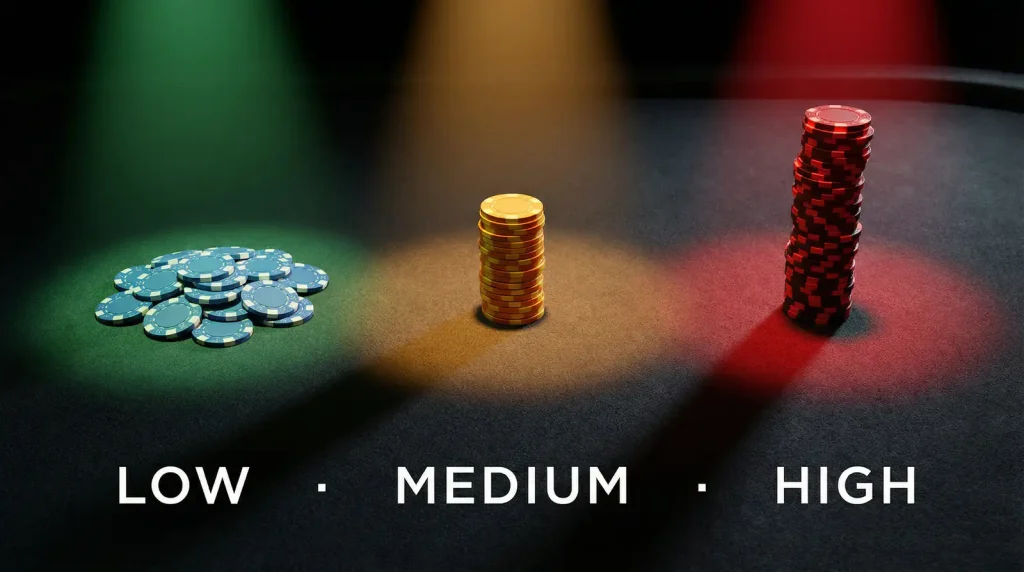
That difference is volatility — sometimes called variance. It describes how a slot distributes its payouts across time. RTP tells you the price of playing. Volatility tells you the rhythm. A low-volatility slot spreads its returns evenly across many small wins. A high-volatility slot concentrates its returns into fewer, larger events separated by longer losing stretches. Medium volatility sits somewhere between the two, though the boundaries are not precisely standardised.
Providers typically label their games as low, medium, or high volatility, though the classification is not always disclosed in the same way. Some show a scale in the paytable; others use descriptive terms in their marketing materials. A few do not disclose it at all, leaving players to infer the volatility from the game’s behaviour in demo mode or from third-party reviews. Regardless of how you find the information, it should be the second number you check after RTP — because it determines whether a slot matches your bankroll, your patience, and your session goals.
Low Volatility — Frequent Wins, Smaller Payouts
Low variance suits players who want longer sessions on a fixed budget. The defining characteristic of a low-volatility slot is a high hit rate: wins land frequently, often on a significant proportion of spins, but the individual payouts are modest. You will rarely see a single spin return more than 10 to 20 times your stake, and the bonus features — if the game has them — tend to deliver consistent but unspectacular results.
The practical effect on your bankroll is stability. A low-volatility session tends to produce a balance graph that drifts slowly downward (because the house edge still applies) with frequent small upticks that slow the decline. You burn through your budget gradually rather than in sudden drops. For a player who deposits £20 and wants an hour of entertainment, low volatility extends the session. You will see more spins, more animations, and more of the game’s features before your balance reaches zero.
The trade-off is ceiling. Low-volatility slots rarely produce the kind of outsized wins that generate excitement on forums or screenshots. The maximum win multiplier is typically lower — often capped between 500x and 2,000x — and the probability of reaching even that cap in a single session is slim. If your definition of a good session involves a moment where your balance jumps dramatically, low volatility is unlikely to deliver it.
Examples of well-known low-volatility slots available in the UK include Blood Suckers by NetEnt (98.00% RTP, max win 900x) and Starburst by NetEnt (96.09% RTP, max win 500x). Both are staples of UK casino lobbies precisely because their gentle payout rhythm appeals to a broad player base.
Medium Volatility — The Balanced Middle Ground
Medium variance gives a mix of frequency and payout size. It is the compromise position — not as gentle as low volatility, not as aggressive as high — and it is where the majority of modern video slots sit. If you pick a random slot from a UK casino lobby without checking its volatility label, there is a reasonable chance it falls into this category.
A medium-volatility session alternates between stretches of modest or absent payouts and occasional wins that are meaningfully larger than your stake. Bonus rounds tend to be more varied in outcome than their low-volatility counterparts: some trigger and pay poorly, others land a decent multiplier or a lucky cascade. The balance graph is less predictable — it dips and recovers in a way that feels more dynamic than low volatility, but without the stomach-dropping droughts of high variance.
For bankroll planning, medium volatility requires a slightly larger buffer than low volatility for the same session length. A budget that sustains an hour on a low-variance slot might last 40 minutes on a medium-variance game at the same stake, simply because the gaps between wins are longer. The upside is that those wins, when they arrive, are larger — sometimes large enough to push your balance above your starting point temporarily, which is an experience low volatility rarely provides.
Gates of Olympus by Pragmatic Play (96.50% RTP, max win 5,000x) and Gonzo’s Quest by NetEnt (95.97% RTP, max win 2,500x) are widely available medium-volatility options in the UK market. Both feature multiplier mechanics that can produce occasional strong payouts without the extreme drought periods of high-variance games.
High Volatility — Rare Wins, Larger Prizes
High volatility can drain a bankroll fast between payouts. This is the format that produces the biggest headlines — 10,000x wins, bonus rounds that pay hundreds of times the stake, screenshots that look too good to be true. It is also the format that produces the longest, most punishing losing streaks. Both outcomes come from the same mathematics.
A high-volatility slot concentrates its return into a small number of large events. The hit rate is lower than medium or low variance: many spins return nothing or less than the stake, and base-game wins that exceed your bet size are comparatively rare. The game’s RTP is maintained not through frequency but through magnitude — when a win does land, particularly in a bonus round, it can be substantial enough to compensate for dozens of empty spins preceding it.
The bankroll impact is severe. A session on a high-volatility slot at a stake level that would be comfortable on a low-variance game will feel entirely different. Your balance will decline faster during dry spells, and the temptation to increase your bet to “recover” is constant. This is the format where bankroll discipline matters most, because the gap between “I can afford this session” and “I’ve spent more than I planned” closes quickly.
Maximum win potential is the compensating factor. High-volatility slots routinely offer max wins of 5,000x to 50,000x or more. Titles like Dead or Alive 2 by NetEnt (96.82% RTP, max win 111,111x) or Money Train 4 by Relax Gaming (96.00% RTP, max win 150,000x) are designed around the possibility of an extreme event — a single bonus round that returns more than most players will see in a year of casual play. The probability of that event is tiny. But it exists, and it is what draws players to the format.
High volatility is not inherently better or worse than low or medium. It is a different product designed for a different tolerance. If you cannot comfortably watch your balance drop to zero without the urge to deposit again, high volatility is not a good match for your current budget or mindset.
Matching Volatility to Your Bankroll and Goals
Choose volatility based on what you can afford to lose, not what you hope to win. This is not a philosophical statement — it is a practical budgeting framework.
If your session budget is £20 and you want to play for at least 30 minutes, low volatility at a low stake gives you the best chance of achieving that. The frequent small wins extend your play time, and the limited downside variance keeps your balance from collapsing in the first five minutes. Medium volatility on the same budget is workable but less predictable. High volatility on £20 is a gamble on a gamble — your session could last 200 spins or 40, depending entirely on whether the RNG delivers early.
If your budget is larger and your goal is the possibility of a significant return — understanding that the most likely outcome is still a loss — high volatility offers a wider range of outcomes per session. The variance works in both directions: you can lose your budget quickly, or you can hit a bonus round that returns multiples of it. That range is the product you are buying.
A useful rule of thumb: your session budget should sustain at least 200 spins at your chosen stake level. For low volatility, this is comfortable. For medium, it is adequate. For high volatility, 200 spins is a minimum — 300 to 500 is more realistic if you want a reasonable chance of reaching at least one meaningful feature round. If your budget does not support that spin count at the stake you have in mind, either lower the stake or choose a less volatile game.
Volatility Is Personal, Not Universal
There is no best volatility — only the right one for your budget and temperament. The slot industry markets high volatility as exciting and low volatility as safe, but these are framing choices, not mathematical truths. Low volatility is not safer in the sense that you will lose less money; it is steadier in the sense that your balance fluctuates less per session. Over enough sessions, the house edge takes the same percentage regardless.
What volatility changes is the shape of the experience. Choose the shape that matches how you actually play — not how you imagine playing on a perfect day, but how you behave after twenty minutes of no wins, or after an unexpected payout, or at the end of a long week when your judgment is not at its sharpest. The right volatility is the one that keeps your session within the budget you set before you started.